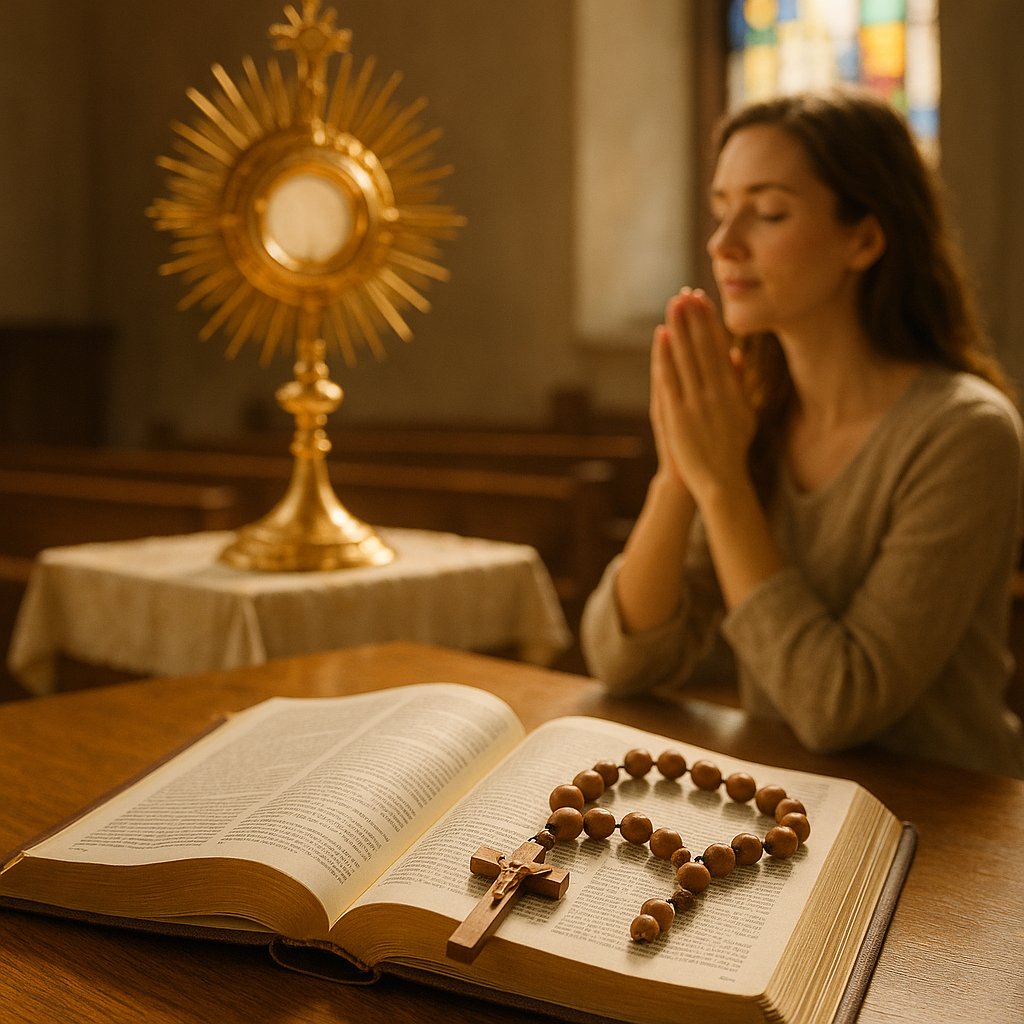
In a world where the background noise never quite stops, silence can feel a little suspicious. We fill every spare moment with music, podcasts, scrolling, or the highly spiritual practice of staring into the fridge for no reason at all. So, when Catholics hear about centering prayer, it’s fair to ask: is this a fruitful way to pray, or something we should approach with a bit of caution?
The short answer is this: centering prayer is a modern method of silent prayer that aims to dispose the person to God’s presence. But because prayer in the Catholic life is never just about technique, it’s important to understand what centering prayer is, what it is not, and how it fits within the Church’s teaching on contemplation.
What Is Centering Prayer?
Centering prayer is a form of silent, receptive prayer developed in the 20th century by Trappist monks, especially William Meninger, Basil Pennington, and Thomas Keating. Its basic method usually includes these steps:
– sit quietly and comfortably
– choose a “sacred word” as a symbol of consent to God’s presence
– when distracted, gently return to the word
– rest in silence before God
Supporters often describe it as a way of consenting to God’s action in the soul rather than trying to “do” prayer through constant thinking or speaking.
It is sometimes presented as a modern expression of the Catholic contemplative tradition, drawing inspiration from early Christian writers and monastic practices. And there is a real Catholic instinct behind that interest: the Church has always valued silence, recollection, and contemplation.

Catholic Contemplation Is Real — and Beautiful
The Catholic Church absolutely teaches that contemplation is part of the Christian life. In the Catechism, contemplative prayer is described as “a gaze of faith, fixed on Jesus” and “silent love” (CCC 2715). That is a beautiful definition, and it reminds us that contemplation is not emptying ourselves into nothingness, but abiding lovingly in the presence of the living God.
Scripture also points us toward this kind of prayer. Jesus Himself withdrew to pray in silence: “In the morning, while it was still very early, he got up and went off to a deserted place, where he prayed” (Mk 1:35, NABRE). And Psalm 46:10 gives the classic invitation: “Be still, and know that I am God.”
So the desire behind centering prayer—to become still before the Lord—is not foreign to Catholic spirituality. In fact, it resonates with it.
Centering Prayer and Traditional Catholic Mental Prayer
Here’s where Catholics need clarity.
Traditional Catholic mental prayer usually involves reflecting on Scripture, the mysteries of Christ, or spiritual truths, followed by a loving response of the mind and heart. Think of meditation on the Gospel, lectio divina, or praying through the Rosary. These forms are deeply Christ-centered and rich in content.
Centering prayer, by contrast, tends to emphasize silence and interior consent with less discursive reflection. That is not automatically bad. But the Church warns that prayer must never become merely a technique for producing a certain state of mind.
The Catechism says meditation engages thought, imagination, emotion, and desire, and it should lead to prayerful union with God, not just a calming exercise (CCC 2705–2708). In other words, Catholic prayer is not spiritual self-help with incense. Charming, maybe. Sufficient, no.
What the Church Says: A Helpful Caution
The most important official reference here is the Congregation for the Doctrine of the Faith’s 1989 document Orationis formas on Christian meditation. It does not condemn all silence or contemplative methods. But it does offer serious cautions.
The document warns against prayer methods that reduce prayer to technique or that blur Christian prayer with non-Christian spiritual systems. It insists that authentic prayer must remain rooted in Christ, revelation, and grace. Christian contemplation is not a mental void; it is communion with the Father through the Son in the Holy Spirit.
That means the Church’s stance is not, “Never be silent.” It is more like, “Be silent, yes—but stay with Jesus.”
And honestly, that is a very Catholic balance. We do not fear silence, but neither do we treat spiritual life like a self-made relaxation protocol.

Why This Matters Spiritually
The appeal of centering prayer is easy to understand. Many Catholics are tired, distracted, and spiritually fragmented. Silence can be healing. Stillness can make room for grace. A prayer method that helps someone slow down and become more attentive to God can be useful.
But there are a few key points Catholics should keep in mind:
1. Contemplation is a gift, not a spiritual achievement
The Church teaches that contemplative prayer is ultimately received from God, not manufactured by a method (CCC 2713–2714). This matters because the spiritual life is not a performance review. You cannot “win” contemplation by being extra quiet and extra impressive.
2. Christ must remain at the center
Any prayer form that sidelines Jesus or makes God seem impersonal drifts away from Catholic faith. Christian prayer is not just reaching for “something beyond”; it is communion with the living God who has revealed Himself in Jesus Christ.
3. Silence should serve prayer, not replace it
Silence is powerful, but it should open us to God’s word, God’s presence, and God’s will. If silence becomes the whole point, we risk confusing inner emptiness with spiritual maturity. Those are not the same thing.
4. A method is not the same as holiness
A person can spend 20 minutes in silence and still be cranky, impatient, and difficult at dinner. Prayer should bear fruit in charity. If a prayer practice makes us less loving, less patient, and less surrendered to God, it needs a closer look.
A Balanced Catholic Approach
For many Catholics, the safest and richest path is to combine silence with the Church’s tried-and-true forms of prayer:
– Lectio divina
– The Rosary
– Eucharistic adoration
– Scripture meditation
– Daily mental prayer
– The Liturgy of the Hours
These practices keep prayer anchored in the Word of God, the life of Christ, and the sacramental life of the Church.
That does not mean every Catholic must pray the exact same way every day. The Church has room for different spiritual temperaments. Some people are more reflective, some more verbal, some more naturally quiet. But whatever our style, prayer should draw us deeper into Christ, not into a vague spirituality where everything is serene and nothing is clear.
If someone uses centering prayer, it should be done with discernment, sound Catholic guidance, and a clear understanding that it is only a method—not the essence of prayer itself.

A Few Practical Questions to Ask
If you’re considering centering prayer, here are some good Catholic discernment questions:
– Does this help me love Jesus more?
– Does it keep me rooted in Scripture and the sacraments?
– Does it lead me to greater humility, repentance, and charity?
– Am I using silence to become attentive to God, or to avoid real prayer?
– Does this practice remain clearly Christian in content and direction?
Those questions matter because not every spiritual method is equally helpful for every Catholic. A practice that seems peaceful on the surface may need more guidance underneath.
Final Thoughts
Centering prayer raises an important Catholic question: how do we enter silence without losing Christ? The answer is not to fear silence, but to fill it with faith. The Church has always prized contemplative prayer, but she also insists that prayer be personal, Christ-centered, and rooted in grace.
If centering prayer helps someone become more recollected and more open to God, it may have a place. But Catholics should always measure any prayer method against the teaching of the Church, especially the Catechism and Orationis formas. The goal is not just inner quiet. The goal is communion with the Lord.
So carve out the silence, turn off the noise, and pray. Just don’t leave Jesus out of the room.
Frequently Asked Questions About Centering Prayer
Is centering prayer the same as Catholic meditation?
Not exactly. Catholic meditation usually involves reflecting on Scripture, the mysteries of Christ, or spiritual truths. Centering prayer emphasizes silent receptivity and interior consent. Both can involve silence, but they are not the same thing.
Is centering prayer allowed for Catholics?
It can be used with caution and discernment, but Catholics should ensure it remains rooted in Christ and does not replace traditional forms of prayer. The Church’s caution in Orationis formas is important here.
What’s the biggest danger with centering prayer?
The biggest danger is turning prayer into a technique or drifting toward a vague spirituality detached from Christ, Scripture, and the sacraments. Catholic prayer is relational, not merely methodical.
What prayer methods are safest for Catholics?
The Church strongly recommends prayer rooted in Scripture and the life of Christ, such as lectio divina, the Rosary, Eucharistic adoration, and the Liturgy of the Hours.