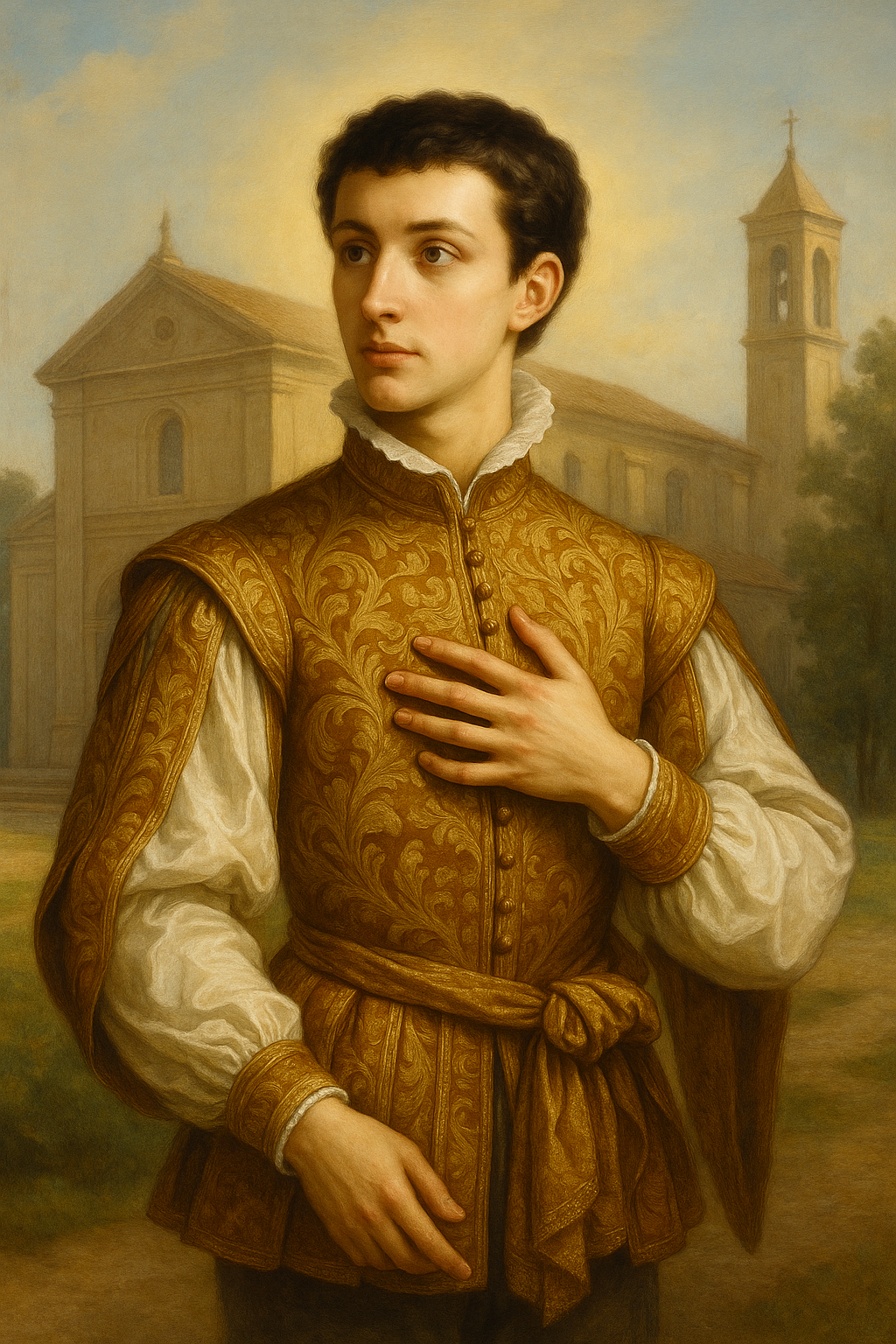
Feast Day: June 21
Let’s be honest: most people do not hear “saint” and immediately think “teenager.” We tend to picture grand cathedrals, long lives of ministry, and enough theological wisdom to fill a library. But St. Aloysius Gonzaga turns that expectation on its head. He became a saint in only 23 years.
In a world that tells young people to “figure it out later,” Aloysius is a flashing neon sign that says holiness starts now. Not after graduation. Not after the career settles down. Not after you finally get your act together. Now.
Born into nobility, surrounded by privilege, and expected to pursue power, Aloysius chose something far more radical: Jesus Christ. And that choice still speaks loudly to Catholic youth, students, and anyone trying to live faithfully in a noisy, pressure-filled world.

Who Was St. Aloysius Gonzaga?
St. Aloysius Gonzaga was born on March 9, 1568, in Castiglione delle Stiviere, Italy, into a wealthy and influential family. As the eldest son, he was expected to inherit his father’s title and step into the world of political and military ambition. In other words, he had the kind of future most families would call “set.”
But Aloysius felt drawn early to prayer, purity, and the religious life.
Even as a child, he showed a striking seriousness about God. Catholic tradition tells us that by around age nine, he had made a private vow of chastity and begun living with unusual discipline in prayer and penance. That may sound almost unreal in our age of endless scrolling and “maybe I’ll pray after one more video,” but it reveals something simple and beautiful: holiness is not about being flashy. It is about giving your whole heart to God.
Aloysius studied in noble courts in Italy and Spain, but the more he saw the vanity of worldly life, the more he longed for Christ. After a long struggle with his father, he renounced his inheritance and entered the Society of Jesus in Rome in 1585. He was only 18.
That is a pretty serious career change.
St. Aloysius Gonzaga and Prayer
Aloysius’ spiritual life was shaped by prayer, the sacraments, and self-discipline. He loved the Blessed Virgin Mary and was known for reciting the Office of Our Lady and the Seven Penitential Psalms. According to Catholic tradition, St. Charles Borromeo gave him his first Holy Communion, which became a treasured moment in his devotional life.
Later, in Rome, his Jesuit formation was guided by St. Robert Bellarmine, one of the great defenders of the faith and a Doctor of the Church. Bellarmine later wrote about Aloysius after his death, testifying to his holiness and charity.
This matters because Aloysius was not just “a good kid” or “well-behaved.” He was spiritually serious. He understood that the Christian life requires grace, discipline, and the willingness to say no to sin so we can say yes to God.
And that is not just old-fashioned piety. It is straight-up Catholic anthropology.
The Catechism teaches that chastity is “a school of the gift of the person” (CCC 2346), and that purity of heart helps us see God (CCC 2518–2519). Aloysius embodied that teaching in a remarkably youthful way.
Takeaway
Holiness is not reserved for later life. A young heart can belong wholly to God.

His Heroic Charity During the Plague
St. Aloysius is perhaps best known for his final act of love. During a plague in Rome in 1591, he volunteered to care for the sick in hospitals. He washed patients, carried them, and served them with compassion. In the process, he contracted the plague himself and died on June 21, 1591.
He was only 23 years old.
That kind of detail can stop us in our tracks. Aloysius did not admire Christ from a safe distance. He followed Him into suffering.
His life echoes Jesus’ words: “No one has greater love than this, to lay down one’s life for one’s friends” (John 15:13, NABRE). It also calls to mind Matthew 25:40: “Whatever you did for one of these least brothers of mine, you did for me” (NABRE).
The Catechism teaches that the corporal works of mercy are among the essential expressions of Christian charity (CCC 2447). Aloysius lived that teaching in a radical way. He saw the suffering Christ in the sick poor.
And that is the heart of Christian love: not sentimentality, but sacrificial service.
Why St. Aloysius Gonzaga Matters Today
St. Aloysius Gonzaga is the patron saint of Catholic youth and students for a reason. He speaks directly to struggles young people still face:
– pressure to fit in
– confusion about identity and vocation
– temptations against purity
– fear of commitment
– the temptation to live only for comfort
Sound familiar? The details change, but the human heart remains wonderfully consistent.
Aloysius shows that youth is not a waiting room for holiness. St. Paul’s words fit him perfectly: “Let no one have contempt for your youth, but set an example for those who believe, in speech, conduct, love, faith, and purity” (1 Timothy 4:12, NABRE).
He also lived Jesus’ call to detachment: “If you wish to be perfect, go, sell what you have and give to the poor… then come, follow me” (Matthew 19:21, NABRE). Aloysius gave up wealth, status, and worldly ambition to follow Christ more freely.
Now, that does not mean every Catholic teenager is called to become a Jesuit. But it does mean every young Catholic is called to take holiness seriously.

What St. Aloysius Gonzaga Teaches Us
Aloysius’ life gives us several timeless lessons.
1. Purity is possible
The culture may mock chastity, but the saints do not. Aloysius reminds us that purity is not repression; it is freedom ordered toward love.
This is important because chastity is often misunderstood as “just saying no.” But the Church sees it as something much richer: integrating the gift of sexuality into a life of self-mastery and true love.
2. Vocation begins with listening
Aloysius discerned God’s call early and kept listening, even when others resisted. Faithful discernment usually begins with prayer, silence, and courage.
If you have ever felt tugged in a direction that made no sense to everyone around you, welcome to the club of the saints.
3. Service is not optional
The Christian life is always concrete. Love shows itself in mercy, sacrifice, and care for the suffering.
We do not just “believe in Jesus” in the abstract. We follow Him into ordinary acts of generosity, patience, and self-gift.
4. Youth can be holy
You do not need to wait until you are older, wiser, or more settled to become a saint. Holiness starts with grace and response.
And honestly, that is good news. The Lord is not waiting for us to become impressive before He calls us.
A Saint for Our Time
In an age of endless distraction, St. Aloysius Gonzaga calls us back to what matters most: prayer, purity, charity, and total surrender to God.
His short life reminds us that the measure of a life is not its length, but its love. That is a very Catholic way to look at things, and a very needed one.
If you are young, struggling with your vocation, or trying to live chastely in a noisy world, ask for his intercession. If you are a parent, teacher, or catechist, consider sharing his story with the young people in your care. He is proof that grace can do great things in a young soul.
And if you have ever thought, “Maybe I’m too young to really make a difference,” Aloysius gently disagrees.
Final Thought
St. Aloysius Gonzaga did not waste his youth. He offered it to God.
May his example inspire us to live with greater purity, greater courage, and greater love. And may we, like him, learn to choose Christ above everything else.