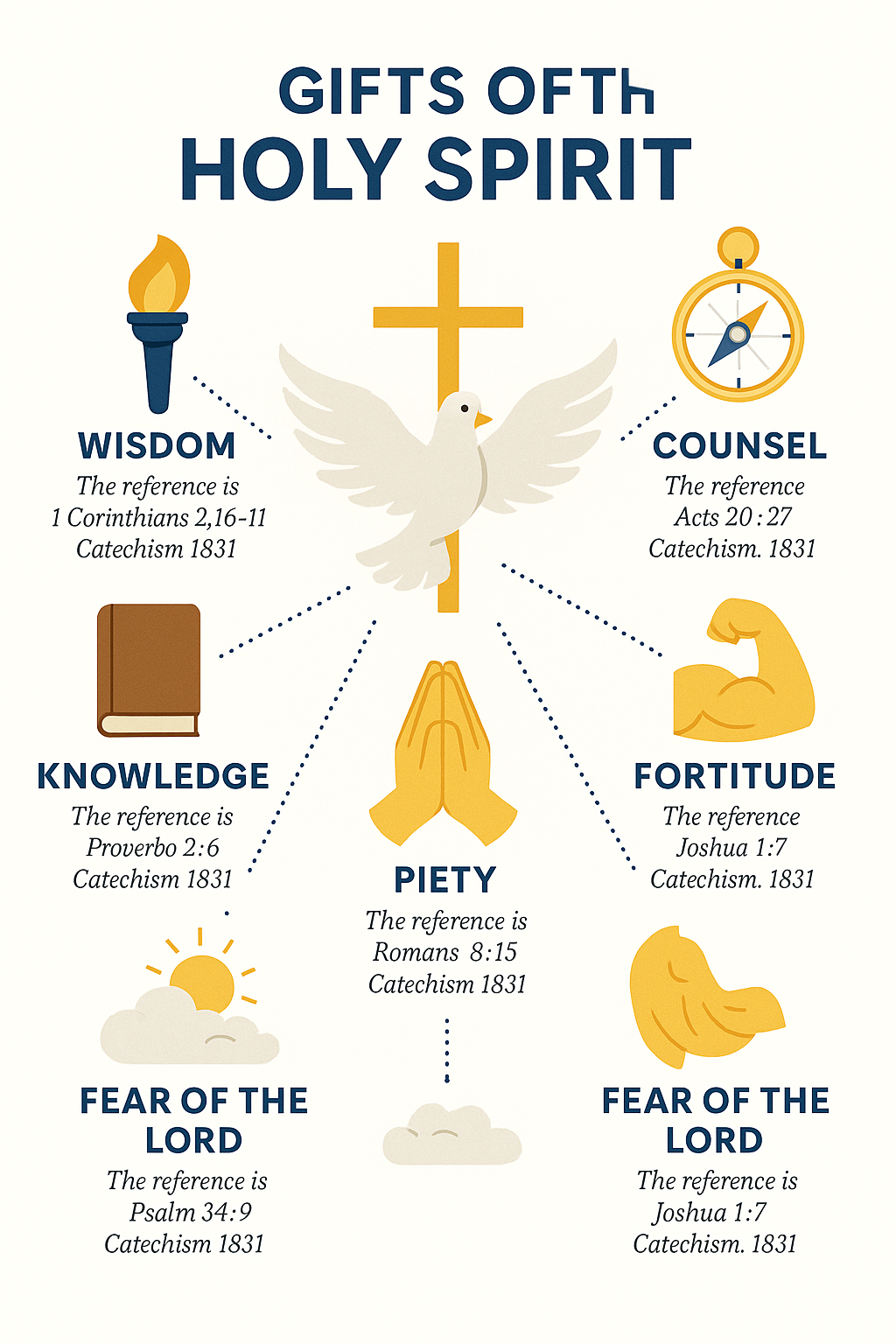
If you’ve ever heard Catholics talk about the seven gifts of the Holy Spirit and wondered, “Okay… but what do they actually do?” you’re in good company. These gifts are not spiritual merit badges for people who already have their life together. They are real helps from God for every baptized Christian—meant to strengthen us for daily life, prayer, decision-making, suffering, and holiness.
In other words: they’re for Monday mornings, not just Pentecost Sunday.
Where the Seven Gifts Come From
The main biblical source is Isaiah 11:2–3, which describes the Spirit resting on the promised Messiah:
“The spirit of the LORD shall rest upon him: a spirit of wisdom and of understanding, a spirit of counsel and of strength, a spirit of knowledge and of fear of the LORD” (Is 11:2, NABRE).
Catholic tradition has long understood this as a prophecy about Christ—and, through Him, about the life of the Church. The Catechism of the Catholic Church names the seven gifts as wisdom, understanding, counsel, fortitude, knowledge, piety, and fear of the Lord (CCC 1830–1831).
So no, this isn’t a random list the Church made up because seven is a nice biblical number. These gifts have deep roots in Scripture and Tradition.

The Seven Gifts Explained
These gifts are not the same thing as natural talents. You can be a gifted musician, a sharp accountant, or the family’s unofficial furniture mover and still need these gifts. The gifts of the Holy Spirit are supernatural dispositions that make us more open to God’s action in our lives.
1. Wisdom
Wisdom helps us see life from God’s perspective. It lets us recognize what actually matters, so we stop treating temporary things like they are eternal treasures.
Wisdom says: God first, everything else in its proper place.
2. Understanding
Understanding helps us grasp the truths of the faith more deeply. It gives light to what we believe, so the Gospel is not just something we can recite on command, but something that sinks in.
It’s the difference between knowing the words and knowing what they mean.
3. Counsel
Counsel, sometimes called right judgment, helps us make good choices. And let’s be honest: life is often a series of choices made without a full user manual.
This gift helps us discern the right path in moral decisions, relationships, vocation, and everyday dilemmas.
4. Fortitude
Fortitude is holy courage. It strengthens us to do what is right even when it is hard, unpopular, or costly.
Think of the martyrs, yes—but also parents, teachers, caregivers, priests, and ordinary Catholics trying to stay faithful in a world that sometimes acts like holiness is a bizarre hobby.
5. Knowledge
Knowledge helps us see created things in relation to God. It teaches us not to confuse passing pleasures with our ultimate goal.
This gift keeps us from making an idol out of what is temporary, shiny, or conveniently marketed.
6. Piety
Piety is loving devotion to God as Father. It is the gift that helps us pray with genuine affection and reverence, not just routine.
It also shapes how we treat others, because if God is our Father, then other people are not random background characters. They are our brothers and sisters.
7. Fear of the Lord
This does not mean being terrified of God. It means reverent awe and a deep desire not to offend Him.
It is the humility that says, “Lord, You are God, and I am not.” Which, frankly, is a very healthy sentence for the human race to remember.
What the Catechism Says
The Catechism gives a beautiful summary of these gifts. It teaches that they:
– sustain the moral life of Christians,
– belong in their fullness to Christ,
– complete and perfect the virtues,
– and make the faithful ready to obey divine inspirations (CCC 1830–1831).
That last point is especially important. The gifts of the Holy Spirit make us docile to God’s movements.
In plain English: they help us cooperate with grace faster and more freely, instead of constantly putting the brakes on every time God nudges us toward something holy.

How the Gifts Relate to Baptism and Confirmation
Catholic teaching connects the gifts of the Holy Spirit closely with Baptism and Confirmation.
In Baptism, we receive sanctifying grace and become children of God. In Confirmation, that grace is strengthened and deepened by a special outpouring of the Holy Spirit.
The Catechism teaches that Confirmation “brings an increase and deepening of baptismal grace” and roots us more deeply in divine sonship (CCC 1302–1305). It also strengthens us to be witnesses of Christ in the world.
So no, Confirmation is not just “Catholic graduation.” It is a sacramental strengthening for mission. The Holy Spirit equips us not only to believe, but to live and witness boldly.
Gifts vs. Charisms: What’s the Difference?
This is a common point of confusion, and for good reason. Catholics use a few Spirit-related words, and they do not mean the same thing.
– Gifts of the Holy Spirit are stable dispositions that help us grow in holiness.
– Charisms are special graces given for the good of others and the building up of the Church.
Both come from the same Holy Spirit, but they serve different purposes. A person might receive a charism of teaching, healing, or administration, while the gifts of the Spirit help that person live as a faithful disciple in the first place.
In other words: charisms are for service; the gifts are for sanctity.
How the Gifts Shape Real Life
The gifts are not abstract theology for the bookshelf. They matter in ordinary life, which is where most of us spend our time, whether we planned it that way or not.
– Wisdom helps when success, popularity, or comfort start looking too important.
– Understanding helps when you read Scripture or the Catechism and want more than surface-level meaning.
– Counsel helps in moral decisions, relationships, vocation, and discernment.
– Fortitude helps when you face fear, temptation, suffering, or spiritual dryness.
– Knowledge helps you stay grounded when the world tries to sell false promises.
– Piety deepens prayer, Mass, and reverence for God.
– Fear of the Lord keeps the heart humble and grateful.
And this is where the whole thing becomes beautifully practical. The Christian life is not just about avoiding bad choices. It’s about becoming the kind of person who naturally turns toward God.
That’s also why the fruits of the Holy Spirit matter so much. Galatians 5:22–23 lists them as “love, joy, peace, patience, kindness, generosity, faithfulness, gentleness, self-control” (NABRE). The gifts help produce that fruit.
A Tradition Rooted in the Saints
St. Thomas Aquinas gave a classic explanation of the gifts, teaching that they dispose us to be moved by the Holy Spirit beyond the limits of human reason alone. St. Augustine also linked the gifts with the Beatitudes, showing how the Holy Spirit shapes the entire Christian life from the inside out.
This is one reason the saints are so striking. They were not perfect because they had better personalities, more willpower, or a more impressive prayer binder. They became saints because they were open to God.
That’s both encouraging and mildly inconvenient, because it means holiness is possible—but not on our own terms.

Living by the Spirit Today
If you want to grow in the gifts of the Holy Spirit, start with a simple prayer:
> Come, Holy Spirit, and make me docile to Your grace.
Then do the ordinary Catholic things well:
– pray daily,
– read Sacred Scripture,
– go to Mass faithfully,
– receive the Sacrament of Reconciliation,
– study the Catechism,
– and ask the Holy Spirit for help before important decisions.
Holiness is usually built in ordinary places: kitchens, car lines, hospital rooms, workplaces, and quiet corners where nobody is applauding. The Holy Spirit is not just for dramatic moments. He is for daily fidelity.
Frequently Asked Questions
Are the seven gifts of the Holy Spirit only for saints or clergy?
No. They are meant for all the baptized. The Holy Spirit gives these gifts to help ordinary Christians grow in holiness and live their vocation well.
Do the gifts of the Holy Spirit disappear if I sin?
The gifts themselves are not the same as sanctifying grace, but mortal sin damages our relationship with God and makes us less responsive to His action. That’s why Reconciliation matters so much. Grace repairs what we have broken.
How can I tell if I’m growing in the gifts?
Look for the fruit. Greater peace, better judgment, deeper reverence, stronger courage, and a more faithful prayer life often point to the Spirit’s work. Growth is usually gradual, not flashy.
Conclusion
The seven gifts of the Holy Spirit are God’s own help for the journey of faith. They make us wiser, stronger, more reverent, more discerning, and more open to God’s will. Far from being rare spiritual decorations, they are part of normal Catholic life.
So the next time you hear them named—wisdom, understanding, counsel, fortitude, knowledge, piety, and fear of the Lord—remember: these are gifts meant to turn an ordinary Christian life into a holy one.
And that’s the whole point.