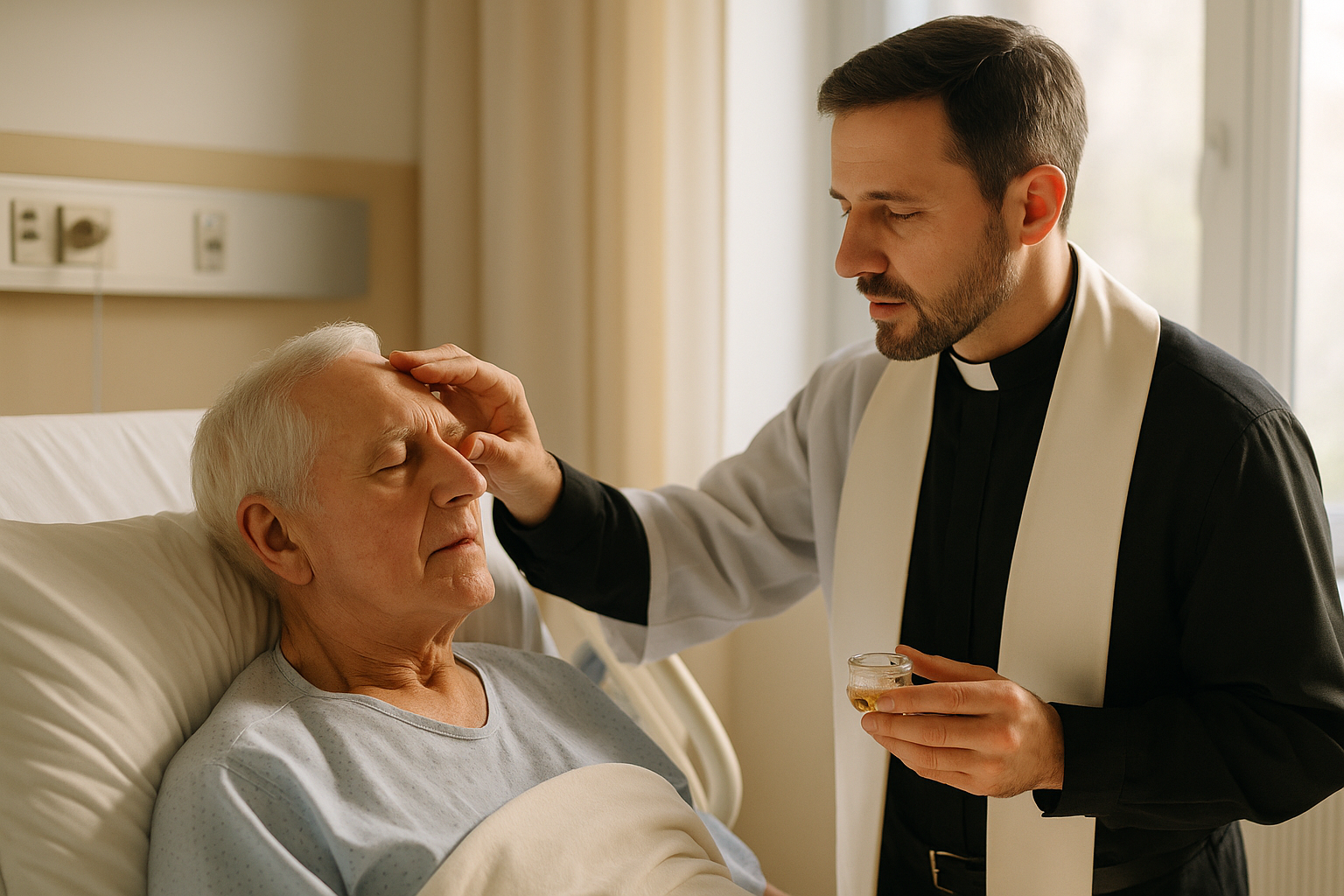
Let’s be honest: a lot of Catholics hear Anointing of the Sick and immediately think, “Ah yes, the sacrament for when someone is really at the end.” And while it absolutely belongs in serious end-of-life situations, that’s only part of the story.
The Church is not handing out a spiritual “good luck, you’re on your own” card here. She is giving us something much better: Christ Himself, drawing near to the sick with grace, peace, forgiveness, and strength.
And that changes everything.

What Is the Anointing of the Sick?
According to the Catechism of the Catholic Church, “by the sacred anointing of the sick and the prayer of the priests the whole Church commends those who are ill to the suffering and glorified Lord” (CCC 1499). In other words, this sacrament is a way the Church places the suffering person directly into the merciful hands of Jesus.
It is a sacrament of healing, but not in the overly narrow, “instant miracle or bust” sense. The healing God gives may be physical, but it is always spiritual too: peace, courage, grace, forgiveness, and deeper union with Christ.
The signs are simple enough that even a sleep-deprived parishioner can follow along: the priest lays hands on the sick person, prays, and anoints them with blessed oil. But beneath those humble signs is real grace. As the Catechism teaches, the sacrament strengthens the sick person with the Holy Spirit and prepares them for what comes next, whether that is recovery or eternal life (CCC 1520–1523).
What Does Scripture Say?
The clearest biblical foundation is James 5:14–15:
“Is anyone among you sick? He should summon the presbyters of the church, and they should pray over him and anoint him with oil in the name of the Lord. And the prayer of faith will save the sick person, and the Lord will raise him up. And if he has committed any sins, he will be forgiven.” (NABRE)
That is a remarkably rich passage. Notice what is happening:
– the sick person calls for the presbyters;
– the priests pray over the person;
– they anoint with oil in the name of the Lord;
– healing and forgiveness of sins are connected to the prayer.
This is not a later Church invention tacked on by medieval Catholics with a flair for ceremony. It is deeply rooted in apostolic Christianity. And it fits beautifully with Jesus’ own ministry: He healed the sick, comforted the suffering, and showed tender mercy to those weighed down by weakness.

Who Can Receive It?
Here’s where people often get tripped up.
The sacrament is not only for someone who is actively dying. Canon Law states that the Anointing of the Sick is to be given to the faithful “who, having reached the use of reason, begin to be in danger due to sickness or old age” (canon 1004). It can also be received before serious surgery if the underlying condition is dangerous.
So who should consider asking for it?
– someone facing a serious illness
– someone whose strength has been seriously weakened by age
– someone preparing for major surgery
– someone with a chronic condition that has become severe
A good rule of thumb: if the situation is serious enough that you’re wondering whether to call the priest, then it’s probably serious enough to ask. Better to call early than wait until everyone is scrambling in a hospital hallway.
What Graces Does It Give?
The Anointing of the Sick gives powerful graces that are easy to underestimate.
1. Strength and peace
The sacrament brings a special gift of the Holy Spirit, strengthening the soul to bear suffering with courage and trust.
2. Union with Christ
The sick person is united more closely to Christ’s Passion. Suffering is not magically erased, but it is taken up into Jesus’ own saving work.
3. Forgiveness of sins
If the person cannot make a normal Confession, the sacrament can forgive sins when there is contrition. That is a breathtaking mercy.
4. Possible bodily healing
God may grant physical healing, though the Church never promises that as automatic. The sacrament is not a vending machine for miracles. It is a sacrament for the good of the whole person.
5. Preparation for death, when needed
If death is near, the sacrament helps prepare the soul to meet the Lord in peace and confidence.

Isn’t This Just the Last Rites?
Not exactly.
“Last Rites” is a broader phrase that can include:
– Confession
– Anointing of the Sick
– Viaticum, which is Holy Communion given as “food for the journey”
So yes, the Anointing of the Sick can be part of someone’s final sacraments. But it is not limited to the dying. Since the Second Vatican Council, the Church has emphasized its fuller meaning as a sacrament for serious illness and weakened health, not merely the very last moments of life.
A Brief Look at the History
In the early Church, Christians clearly connected prayer, anointing, and healing. Over time in the West, the sacrament became more closely associated with death and was often called Extreme Unction.
That wasn’t wrong so much as incomplete.
Vatican II helped restore the fuller biblical and pastoral understanding, and the Church now commonly speaks of the Anointing of the Sick to highlight its wider purpose. That was not a downgrade. It was a recovery.
The Church, as it turns out, sometimes remembers what Jesus and the apostles were doing before we get too clever for our own good.
Common Misunderstandings
Let’s clear up a few myths, because this sacrament has collected a surprising number of them.
– “It’s only for the dying.”
No. It is for the seriously ill and the elderly in weakened health.
– “You can only receive it once.”
No. It may be received again if the illness worsens or a new serious illness arises.
– “It guarantees a cure.”
No. Physical healing may happen, but the sacrament’s primary gift is spiritual strength and peace.
– “It means God has given up.”
Absolutely not. It means Christ is drawing near in a special way.
Why It Matters Today
We live in a world that often fears illness, weakness, and dependence. We celebrate strength, productivity, and “having it together,” which is great until life politely reminds us that none of us is in charge.
The Anointing of the Sick quietly tells a very different story: human dignity does not vanish when health fades. A person is not less loved by God because they are weak. In suffering, the Lord often meets us with extraordinary tenderness.
And this sacrament teaches the rest of the Church how to love. We are not called to disappear when someone is sick. We are called to pray, accompany, and trust that Christ is truly present in their pain.
Conclusion
The Anointing of the Sick is one of the Church’s most consoling sacraments. It is a gift of Christ’s mercy for those facing serious illness, old age, or major surgery. It strengthens the soul, forgives sins when needed, unites suffering to Jesus, and brings peace in the face of fear.
If you or a loved one is seriously ill, don’t wait too long to call your priest. And if you are healthy today, take a moment to thank God—and pray for those who are suffering.
The Lord still says to His Church: “I am with you.” And in this sacrament, He means it quite literally.