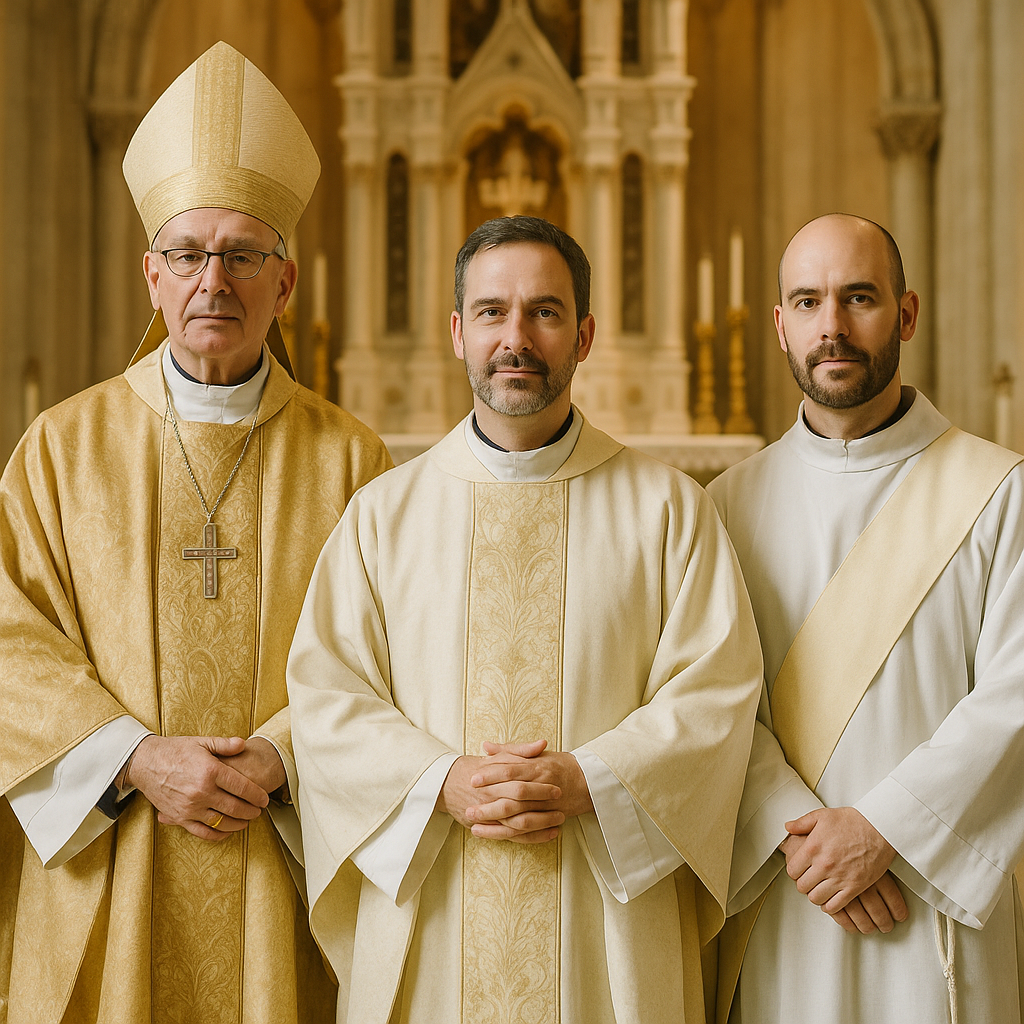
If you’ve ever sat in the pew and thought, “Okay, but how does the Church actually keep going from the apostles to my parish priest?” — congratulations, you’ve stumbled onto one of Catholicism’s most beautiful answers: Holy Orders.
Now, before this starts sounding like a theology final exam, let’s keep it simple. Holy Orders is the sacrament through which Christ continues His teaching, sanctifying, and shepherding work in the Church through bishops, priests, and deacons. In other words, Jesus did not start the Church and then ghost it. He remains active in her through ordained ministry.

What Is Holy Orders?
The Catechism of the Catholic Church calls Holy Orders “the sacrament of apostolic ministry” (CCC 1536). That’s a pretty elegant way of saying that the mission Jesus gave the apostles did not end when they died. It continues in the Church through ordination.
Through the laying on of hands and the prayer of consecration, a man is set apart for sacred ministry. This is not a mere administrative appointment, like naming someone head of the parish pancake breakfast committee. It is a sacramental act with real spiritual power.
Scripture shows this pattern clearly. In Acts 6:1–6 (NABRE), the apostles lay hands on the first deacons. In Acts 13:2–3, Paul and Barnabas are set apart for mission by prayer and the laying on of hands. And in 2 Timothy 1:6, St. Paul tells Timothy to “stir into flame the gift of God that you have through the imposition of my hands.”
That is the apostolic Church in action.
The Biblical Roots of Holy Orders
Holy Orders did not appear out of thin air in the Middle Ages, no matter how many people imagine the Church was invented by monks with excellent organizational skills and very serious hats.
From the beginning, the apostles exercised authority by appointing others to serve with them. Christ Himself chose the Twelve and gave them authority to teach, govern, and sanctify. After the Ascension, that ministry continued through ordained men who were selected, prayed over, and commissioned.
This is why Catholics see Holy Orders as part of the Church’s DNA. It is rooted in Christ’s own way of building His Church.
The Three Degrees of Holy Orders
Holy Orders has three degrees: bishops, priests, and deacons (CCC 1536, 1554).
Bishops: The Fullness of Holy Orders
A bishop receives the fullness of the sacrament. He is a successor of the apostles and is entrusted with teaching, governing, and sanctifying the Church in a particular diocese.
That means a bishop is not simply a church administrator in a nicer outfit. He is a father in Christ, a guardian of apostolic faith, and a visible sign that the Church is still built on the apostles.
The Catechism says that episcopal ordination “makes him a real and legitimate successor of the apostles” (CCC 1577). That is a weighty phrase because the office is weighty. A bishop’s mission is to preserve the unity of the Church and hand on the faith faithfully.
Priests: Co-workers with the Bishop
Priests are ordained to serve with and under their bishop. They preach the Gospel, celebrate the Eucharist, forgive sins in the sacrament of Reconciliation, and care for God’s people in parishes, schools, hospitals, campus ministries, and mission fields.
At Mass, the priest acts in persona Christi Capitis — in the person of Christ the Head. That sounds technical, but the meaning is actually stunning: when the priest consecrates the Eucharist, Christ Himself is acting through him.
So no, a priest is not just a nice man with a collar and a microphone. He is a sacramental instrument of Christ’s own priesthood. Which is a much bigger job than running the parish bulletin.
Deacons: Ordained for Service
Deacons are ordained for service. They assist at the altar, proclaim the Gospel, preach, witness marriages, preside at funerals, and carry out works of charity.
The word deacon comes from the Greek diakonia, meaning service. That is not a coincidence. Jesus said plainly, “For the Son of Man did not come to be served but to serve and to give his life as a ransom for many” (Mk 10:45, NABRE). Deacons make that truth visible in a special way.
Their ministry is a reminder that in the Church, authority is never supposed to be about self-importance. It is about service. Very unglamorous, very Christian, and very necessary.

Apostolic Succession: Why It Matters
Holy Orders is inseparable from apostolic succession — the unbroken line of bishops stretching back to the apostles through the laying on of hands.
This matters because it means the Church today is not just a religious group that started yesterday and is still brainstorming its identity. The same apostolic faith is handed on. The same Eucharist is celebrated. The same sacraments are offered. The same pastoral mission continues.
The Second Vatican Council teaches that bishops, by divine institution, are successors of the apostles and are charged with preserving the Church’s apostolic mission. That’s why Catholics care about valid ordination and communion with the bishop and the Pope. It’s not clerical trivia. It’s fidelity to Christ’s plan for His Church.
What Holy Orders Does to the Ordained Man
According to the Catechism, ordination configures the man to Christ by a special grace of the Holy Spirit (CCC 1581). It also leaves an indelible spiritual character — meaning Holy Orders is received once and cannot be erased or repeated (CCC 1582).
That means a man who has been ordained is always ordained, even if he later leaves active ministry. The sacrament marks him permanently.
That permanence is one reason the Church treats ordination with such reverence. It is not a temporary role. It is a lasting sacramental reality.
The Catechism also reminds us that the unworthiness of the minister does not prevent Christ from acting through the sacrament (CCC 1584). Thank God for that. The holiness of the sacraments depends on Christ, not on the personal perfection of the man holding the chalice.
Because if sacraments depended on the priest having a flawless week, well… let’s just say the Church would be in trouble every Monday morning.
Holy Orders and Vocation: A Call, Not a Career
Holy Orders is not a career path like choosing between accounting and engineering. It is a vocation — a call from God that must be discerned in the Church.
Usually that discernment involves prayer, spiritual direction, service, study, and a growing desire to give one’s life to Christ and His people. A vocation is not about asking, “What seems impressive?” It’s about asking, “What is God asking of me?”
Only baptized men can validly receive Holy Orders in the Catholic Church. This is not a cultural preference or a temporary policy. It is the Church’s faithful obedience to Christ’s own example and the constant Tradition she has received.
For a man discerning priesthood or the diaconate, the right question is not, “Would I look good doing this?” It is, “Am I being called to serve?” That’s a much better question — and a much holier one.

Why Holy Orders Matters for Catholics Today
Holy Orders is not just for seminarians, bishops, or people who can identify different vestment colors at a glance. It affects every Catholic life.
Without ordained ministry:
– there is no Eucharist
– there is no sacramental absolution in Confession
– there is no bishop to preserve apostolic unity and teaching
– there is no deacon to model ordained service so clearly
So yes, Holy Orders matters to all of us. It is one of the reasons the Church is a living sacramental Body, not just a group of people sharing religious opinions over coffee and donuts.
It also reminds us that the Church is meant to be ordered toward service. Bishops, priests, and deacons are not supposed to be spiritual celebrities. They are servants of Christ and His people.
That may not make for flashy headlines, but it makes for a holy Church.
A Church Built on Christ, Carried by Men
Here’s the beautiful part: Christ loves His Church so much that He gives her shepherds.
He does not leave us to figure everything out on our own. Through ordained ministry, He continues to preach, forgive, sanctify, and guide. Holy Orders is one of the ways Jesus keeps caring for His people in a tangible, sacramental way.
So, the next time you see a bishop, priest, or deacon, remember: you are not just looking at a church official. You are seeing a sign of Christ’s continuing presence in His Church.
Pray for your priests. Pray for your deacons. Pray for your bishop. And if you are discerning a vocation, take heart: the Church still needs generous men willing to say yes to Jesus.
Holy Orders is not just about what priests and deacons do. It is about what Christ continues to do through them — for the salvation of the world.
FAQ: Catholic Holy Orders
What is the sacrament of Holy Orders?
Holy Orders is the sacrament by which Christ continues His apostolic ministry in the Church through bishops, priests, and deacons.
Why is apostolic succession important?
Apostolic succession ensures that the Church’s teaching, sacraments, and mission remain connected to the apostles and therefore to Christ Himself.
Can women receive Holy Orders in the Catholic Church?
No. The Catholic Church teaches that only baptized men can validly receive Holy Orders.
What is the difference between a priest and a deacon?
A priest is ordained to preach, celebrate the Eucharist, and forgive sins sacramentally. A deacon is ordained primarily for service, including proclaiming the Gospel, assisting at the altar, and works of charity.
Does a priest remain a priest forever?
Yes. Holy Orders leaves an indelible spiritual character, so ordination cannot be erased or repeated.