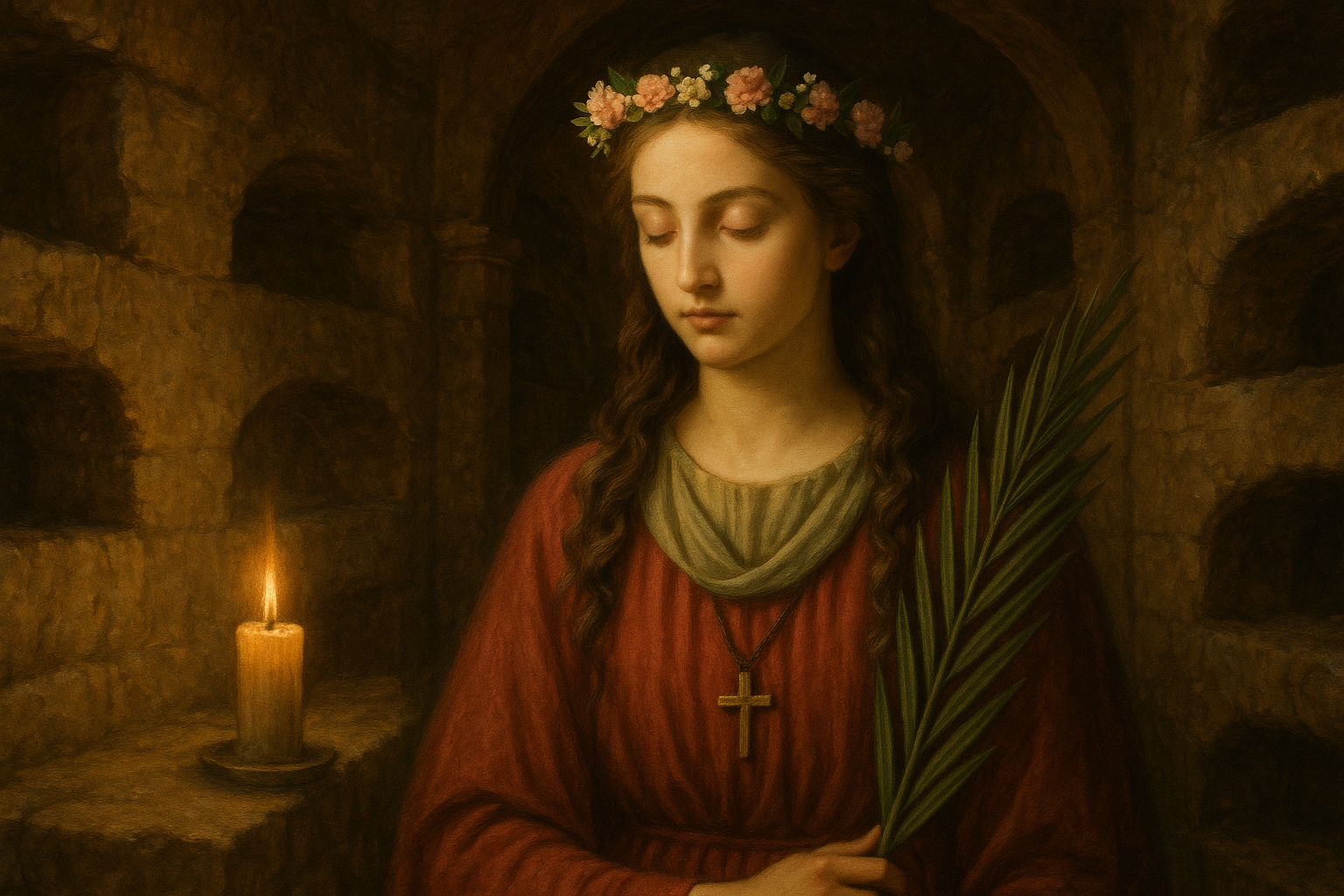
Feast Day August 11.
Saint Philomena is one of those saints who seems to arrive quietly and then leave a huge impact. Saint Philomena reminds Catholics that God can do extraordinary things with a life the world might overlook. We know very little with historical certainty about her life, yet her witness has inspired saints, popes, and countless ordinary believers for more than two centuries.

Who Was Saint Philomena?
Historically, the Church can say with confidence that Saint Philomena was a young Christian martyr whose relics were discovered in Rome in 1802. Her tomb was found in the Catacomb of Priscilla with an inscription identifying her as a martyr, along with symbols connected to martyrdom. Those signs pointed to a young woman who had given her life for Christ.
Beyond that, the details become less certain. The familiar account of Philomena as a young Greek princess who consecrated her virginity to Christ and suffered under Emperor Diocletian comes from 19th-century private revelations reported by Sister Maria Luisa di Gesù and two other people in different parts of Italy. That tradition has nourished devotion for generations, but it is not the same thing as ancient historical documentation.
So, the careful Catholic way to speak about her is simple: we know she was a martyr; we also have a cherished devotional tradition that has helped many Catholics grow closer to Christ.
Now before this starts sounding like a footnote from a theology textbook, here’s the practical point: even when history gives us only part of the picture, the Church still sees a real witness worth honoring. Saints do not need a full biography to become powerful intercessors.
Why Catholics Love Saint Philomena
Even with limited historical data, devotion to Saint Philomena spread quickly after her relics were transferred to Mugnano del Cardinale near Naples. Reports of healings and favors multiplied, and many Catholics began to invoke her as a powerful intercessor.
Her name is often understood as meaning “daughter of light,” which fits beautifully with the Christian vision of martyrdom. A martyr is someone who bears witness to Christ so fully that even suffering and death cannot extinguish the light of faith.
That is why she is often called:
– The Wonder-Worker
– The Little Saint
– A patroness of impossible causes
– A friend of the young and the suffering
These titles reflect devotion rather than dogma, but they reveal something deeply Catholic: the saints are not distant spiritual celebrities. They are living members of the Body of Christ who continue to pray for us.
What Scripture Teaches Us About Martyrdom
Saint Philomena’s witness fits perfectly within the biblical understanding of martyrdom. Jesus says, “Whoever wishes to come after me must deny himself, take up his cross, and follow me” (Mark 8:34, NABRE). That is the logic of Christian discipleship: love is proven through self-gift.
St. Paul gives us the same hope in Romans: “We know that all things work for good for those who love God” (Romans 8:28, NABRE). For a martyr, that promise is not abstract. It becomes concrete in suffering, fidelity, and final surrender to God.
And in Revelation, the martyrs are seen “holding palm branches in their hands” (Revelation 7:9, NABRE), a sign of victory. That image is especially fitting for Philomena, whose traditional symbols include the palm of martyrdom.
The Church has always understood martyrdom not as a tragic loss but as a victory in Christ. The Catechism calls martyrdom “the supreme witness given to the truth of the faith” and a sign of love carried “to the point of death” (CCC 2473). In other words, martyrs do not lose their lives in the deepest sense. They offer them to Christ.

What the Church Says About Her Devotion
The Catechism teaches that the saints in heaven continue to care for us and intercede before God. “Being more closely united to Christ, those who dwell in heaven fix the whole Church more firmly in holiness” (CCC 956). It also reminds us of the communion of saints, meaning that our spiritual family includes those already with the Lord.
That is why devotion to Saint Philomena is not superstition. Catholics do not worship saints; we ask them to pray for us.
That distinction matters. The Church allows and encourages legitimate private devotion to saints, but private revelations and devotional traditions are not part of the deposit of faith. So, if you love Saint Philomena, you are free to honor her with confidence while still keeping a clear sense of what is historically certain and what belongs to pious tradition.
This is one of those wonderfully Catholic balances that can make outsiders blink a little: the Church is very comfortable saying, “Yes, pray with confidence,” and also, “Let’s be precise about what we know.” Both truths can live together peacefully, like coffee and donuts after Mass.
Saints and Popes Who Loved Saint Philomena
One reason her devotion spread so strongly is that holy people loved her too.
St. John Vianney, the Curé of Ars, had a deep devotion to Saint Philomena and often recommended her intercession to others. He attributed many favors to her help and called her his “little saint.”
Pope Gregory XVI approved her public liturgical veneration in the 19th century, which helped strengthen her cult. Other saints and faithful Catholics also turned to her in moments of illness, anxiety, and desperation.
That does not mean every devotional claim about her is equally well documented. But it does show that devotion to Saint Philomena has deep roots in Catholic life, not just in private enthusiasm.
And that matters, because saints often become beloved not through academic certainty but through spiritual fruit. If a devotion leads people to prayer, repentance, hope, and deeper trust in Christ, the Church pays attention.
Patroness of the Young, the Pure, and the Hopeful
Saint Philomena is often invoked as a patroness of:
– Children and youth
– Students
– Purity and chastity
– Newlyweds
– The sick
– Infertility
– Difficult or “impossible” causes
Why these patronages? Because her story, whether told historically in brief or devotionally in fuller form, speaks to courage, purity, and hope in the face of suffering. She is especially beloved by people who feel overwhelmed or forgotten. In that sense, she feels very close to the Gospel.
This is especially beautiful for young Catholics. The world loves to tell young people that they need more time, more influence, more money, more visibility. Saint Philomena quietly answers: holiness is enough.
And that is a very encouraging message for anyone who has ever wondered whether hidden fidelity really matters. It does. A life lived for Christ, even if no one on earth fully understands it, is never wasted.
A Saint for Hidden Faithfulness
There is something beautiful about a saint whose life is partly hidden from us. Saint Philomena reminds us that holiness does not depend on fame, documentation, or a long biography. God sees what others miss.
She also reminds us that youthful faith matters. Young Catholics sometimes feel their witness is too small to count. Saint Philomena says otherwise. A teenage girl, faithful unto death, can still change the Church centuries later.
That is a powerful message for parents, teens, catechists, and anyone trying to stay faithful in a noisy world: quiet holiness is never wasted.
This actually has a lot to do with everyday life. Most of us are not called to dramatic public martyrdom. We are called to ordinary fidelity: praying when we do not feel like it, staying chaste when the world rolls its eyes, forgiving when our pride wants a dramatic exit, and trusting God when our efforts seem unnoticed. Saint Philomena reminds us that those hidden sacrifices matter deeply to God.
How to Pray with Saint Philomena
If you want to grow in devotion to Saint Philomena, try something simple:
1. Read a short passage from Scripture each day.
2. Ask Saint Philomena to pray for purity, courage, or perseverance.
3. Visit Mass regularly and receive the sacraments.
4. Pray for someone facing a difficult trial.
5. Learn more about the communion of saints in the Catechism.
A simple prayer could be:
Saint Philomena, courageous martyr and faithful friend of Christ, pray for us that we may remain pure, steadfast, and full of hope. Amen.
You can also add her to your family prayer routine, especially if you are praying for a child, a student, or someone carrying a burden that feels too heavy. The saints are wonderfully practical that way. Heaven is not disconnected from ordinary life; it is deeply interested in it.
Final Thoughts
Saint Philomena may be hidden in history, but she is not hidden in heaven. Her life, whether known through archaeological evidence or cherished tradition, points us to one truth: Christ is worth everything.
Her story invites us to trust God in suffering, to value purity and fidelity, and to believe that even small, hidden acts of faith can become radiant witnesses to the world.
If you have never prayed to her before, today is a perfect day to begin. Saints like Philomena remind us that God loves to take what seems small and make it shine.
FAQ About Saint Philomena
Is Saint Philomena a real saint?
Yes. The Church recognizes Saint Philomena as a martyr whose relics were discovered in Rome. The fuller story of her life comes from later devotional tradition, but her holiness and intercessory role have long been honored in Catholic devotion.
Why is Saint Philomena called a wonder-worker?
Because many Catholics have reported favors, healings, and answered prayers through her intercession. The title reflects devotion and testimony, not a formal doctrinal definition.
Can Catholics pray to Saint Philomena?
Yes. Catholics may ask saints to pray for them because of the communion of saints. We do not worship saints; we honor them as friends of Christ and members of His Body.
What is Saint Philomena the patron saint of?
She is often invoked for youth, purity, students, the sick, newlyweds, infertility, and difficult causes.
You can read more by visiting the following website: