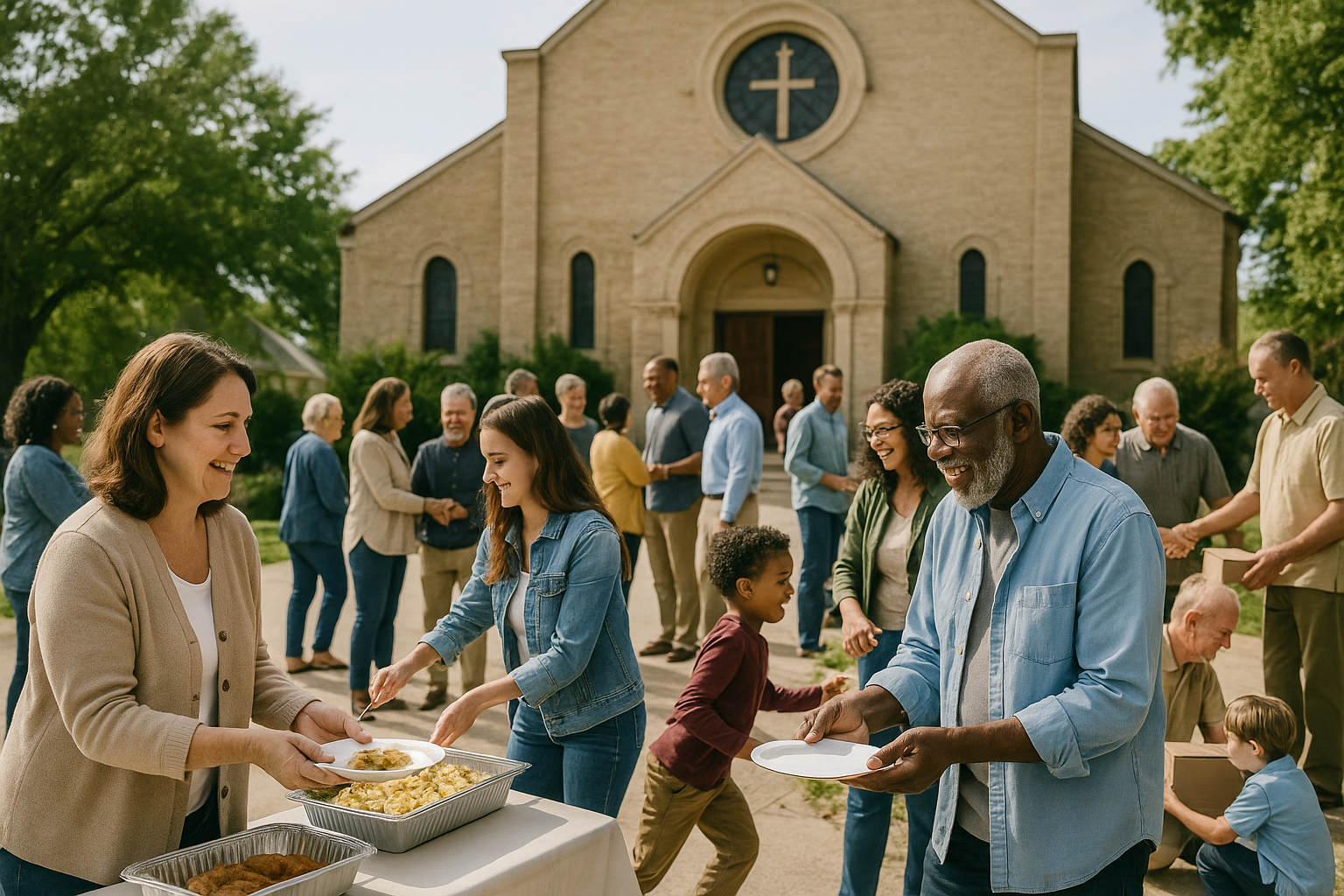
It’s easy to imagine faith as a very private thing—just me, God, and whatever pew I manage to find after arriving five minutes late. But Catholic teaching keeps nudging us toward something bigger, richer, and frankly more challenging: the Catholic call to family, community, and participation. We are made for family, called into community, and sent to help build the common good.
That’s not just a warm-and-fuzzy idea for church bulletins. It’s part of the Church’s moral vision for human life.
This Catholic social teaching reminds us that human beings are both sacred and social. In other words, every person has infinite dignity, but that dignity is meant to flourish in relationship with others. How we live in our homes, parishes, neighborhoods, and civic life matters more than we sometimes want it to.

Why Family Comes First
The Church teaches that the family is the first and most basic community in human life. The U.S. bishops say it plainly: “Marriage and the family are the central social institutions that must be supported and strengthened, not undermined.” That’s a strong statement—but a necessary one.
Why? Because the family is where we first learn how to love, forgive, share, obey, and sacrifice. It’s the original school of virtue. Before we ever learn theology words like “subsidiarity” or “common good,” we’re learning whether to take turns, tell the truth, and not hit our siblings in the car on the way to Mass.
Now before this starts sounding like a parenting seminar, let’s bring in Scripture.
In Deuteronomy 6:6–7 (NABRE), God tells His people to keep His commandments in their hearts and teach them to their children:
“Keep repeating them to your children. Recite them when you are at home and when you are away, when you lie down and when you get up.”
That’s a beautiful picture of faith as something woven into ordinary life, not reserved for Sundays and major feasts. Likewise, Joshua 24:15 gives one of the Bible’s clearest family declarations:
“As for me and my household, we will serve the LORD.”
That’s not just a nice wall sign. It’s a Catholic way of life.
The Catechism calls the family the “domestic church” because it is the first place children encounter the faith, witness love lived out, and learn what discipleship looks like in daily life. When families are strong, society is strengthened too. When families are wounded or unsupported, the whole social fabric feels it.
Community Is Not Optional
Catholicism is deeply communal. We are not saved as isolated spiritual freelancers. We are members of the Body of Christ.
Saint Paul says this beautifully in 1 Corinthians 12:12–27. He compares the Church to a body with many parts. Each member matters. No one gets to say, “I don’t need you.” The eye cannot do the work of the foot, and the hand cannot pretend the body is complete without the rest.
That image applies not only to the Church but also to human society. The Gospel forms people who know how to live with others, not merely beside them. That means learning patience, listening, hospitality, and concern for people who are different from us.
The early Church lived this in a strikingly visible way. Acts 2:42–47 tells us that the first Christians devoted themselves to the apostles’ teaching, fellowship, the breaking of bread, and prayer. They shared possessions and cared for those in need. In other words, community was not an accidental byproduct of faith—it was one of its fruits.
Catholic social teaching draws from that biblical vision. Participation means the voluntary and generous engagement of a person in social life, and the Church teaches that everyone should take part in promoting the common good according to his or her role.
That includes:
– families
– parishes
– workplaces
– neighborhoods
– schools
– civic life

Participation: A Right and a Duty
Here’s where the theme gets especially practical. Catholics believe people have both a right and a duty to participate in society. That means we are not called to be passive spectators in the drama of human life.
If we can contribute to the good of our community, we should.
The Catechism defines the common good as “the sum total of social conditions which allow people, either as groups or as individuals, to reach their fulfillment more fully and more easily” (CCC 1906). It also says the common good should make accessible what people need to live a truly human life: food, clothing, health care, work, education, and the ability to establish a family (CCC 1908).
That’s a powerful definition. The common good is not about making everyone identical or pretending differences don’t exist. It’s about creating conditions where real people can flourish.
Participation, then, is not only about voting, though voting matters. It also includes:
– serving in parish ministries
– helping neighbors in need
– speaking up for the vulnerable
– building healthy families
– joining civic organizations
– supporting local schools and community efforts
Even the ordinary stuff counts. A parent caring for children, a worker doing honest labor, or a parishioner serving quietly behind the scenes is participating in the common good.
Scripture and the Poor Matter Too
Catholic teaching on participation is never only about social structure. It is always about love. And love has a special concern for the poor and vulnerable.
Jesus makes this unmistakable in Matthew 25:31–46. He identifies Himself with the hungry, the thirsty, the stranger, the sick, and the imprisoned. In Catholic life, concern for the poor is not optional charity for when we “have time.” It is part of discipleship.
The Good Samaritan in Luke 10:25–37 gives the same lesson. True neighborliness crosses boundaries and notices those in need. And James 2:14–17 reminds us that faith without works is dead.
So Catholic participation is not just a theory about society. It is a lived response to Christ.

What This Means for Parish Life
Parishes should be places where family, community, and participation are visibly alive. That means more than friendly coffee and donuts, though those certainly help. A solid parish donut table may not save the world, but it can do wonders for fellowship.
A parish can live this teaching by:
– supporting marriages and families with strong preparation and accompaniment
– offering catechesis that involves parents, not just children
– creating welcoming spaces for singles, widows, divorced persons, and families in crisis
– inviting parishioners into liturgical and ministerial service
– forming small groups for prayer, faith sharing, and outreach
– encouraging nonpartisan civic engagement rooted in Catholic teaching
A parish should feel less like a religious service station and more like a living Christian community. The goal is not just attendance. It is belonging, discipleship, and mission.
What This Means for Family Life
Families can live this teaching in simple, beautiful ways:
– pray together regularly
– attend Sunday Mass faithfully
– talk about Scripture at home
– serve together in charity
– teach children responsibility and compassion
– practice listening and forgiveness at home
These habits train the heart for participation in the wider world. A child who learns to share at home is better prepared to share in society. A family that prays together is better prepared to serve together.
And yes, family prayer can be messy. Someone will forget the Rosary mystery. Someone will sigh dramatically. Someone will insist they already prayed this week because they mumbled a Hail Mary while looking for a snack. But God works through ordinary family life, not despite it.
A Final Word
The Catholic call to family, community, and participation is really a call to live like the Body of Christ. We belong to one another. Family is not a private hobby, community is not a luxury, and participation is not reserved for experts.
God made us for communion. He calls us to build up families, strengthen parishes, and contribute to the common good with generosity and faith.
So, take a moment today to ask:
– How can I strengthen my family?
– How can I participate more fully in my parish?
– How can I serve the common good, especially the poor and vulnerable?
The answer may begin with something small: a prayer, a phone call, a ministry, a meal, a conversation. But in Catholic life, small acts of love can help build a very large kingdom.
FAQ
What does the Catholic Church mean by family, community, and participation?
It means that human beings are made for relationship, not isolation. The family is the first community, the Church is a communion, and every person has a duty to contribute to the common good.
Is participation only about politics?
No. Politics is one part of participation, but not the whole thing. Participation also includes family life, parish involvement, service to neighbors, work, education, and care for the vulnerable.
Why does the Church emphasize the family so much?
Because the family is where people first learn love, responsibility, sacrifice, and faith. It is the domestic church and the foundation of social life.
How can I live this teaching if my family is struggling?
Start small. Pray when you can, seek healing where needed, serve others, and stay connected to the sacraments and parish life. The Church walks with families in every season, not just the tidy ones.