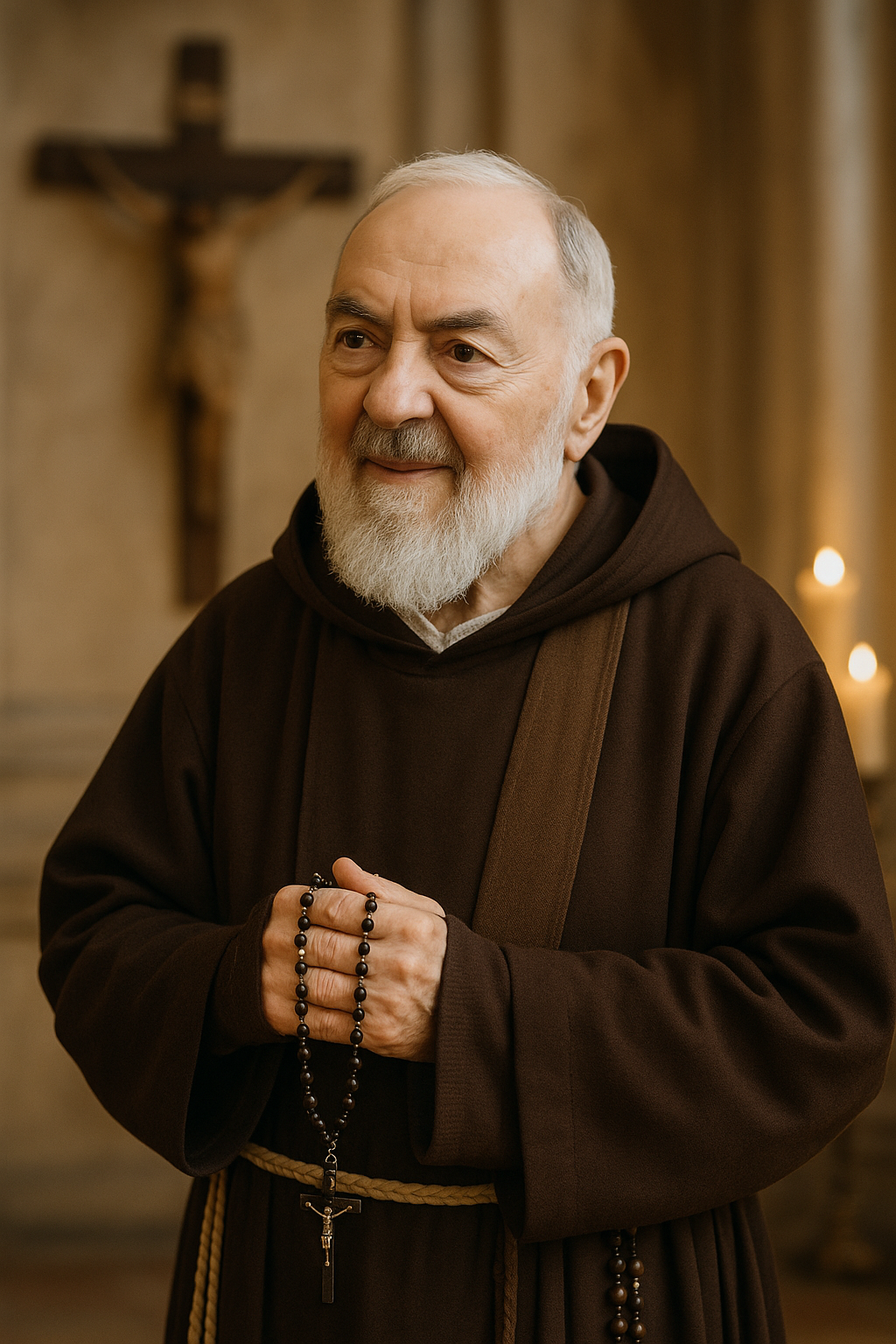
St. Padre Pio is one of those saints people discover and then promptly start quoting like an old family friend. Maybe it’s the stigmata. Maybe it’s the endless confessional line. Maybe it’s his famously simple advice: “Pray, hope, and don’t worry.” Whatever first draws you in, St. Padre Pio has a way of cutting through spiritual fog and getting straight to the point.
And honestly, that is part of why he matters so much today. In a world buzzing with anxiety, noise, and the occasional completely unnecessary panic spiral, Padre Pio reminds us that holiness is not about looking impressive. It is about belonging completely to Christ.

Who Was Padre Pio?
Padre Pio was born Francesco Forgione on May 25, 1887, in Pietrelcina, Italy. He entered the Capuchin Franciscans and was ordained a priest. Much of his ministry unfolded in San Giovanni Rotondo, where he became known for intense prayer, strict discipline, and a confessional ministry that sometimes seemed to go on longer than a parish coffee hour after Mass.
The Church officially recognized his holiness when Pope St. John Paul II beatified him in 1999 and canonized him on June 16, 2002. His liturgical memorial is celebrated on September 23, the anniversary of his death.
What made Padre Pio so compelling was not just the extraordinary things surrounding his life, but the ordinary fidelity underneath them. He celebrated Mass with deep reverence, heard confessions for long hours, and urged people to conversion. In other words, he took the priesthood seriously. That may sound simple, but in any age, simple fidelity is a small miracle.
St. Padre Pio and the Mystery of the Stigmata
Padre Pio is most famous for bearing the stigmata: the wounds of Christ in his hands, feet, and side. These were first reported in 1918 and remained with him for decades. The Church investigated these phenomena carefully, as it should. Catholics do not canonize someone because of spectacle. Extraordinary signs may attract attention, but sanctity is measured by heroic virtue.
That distinction matters.
The Catechism teaches that Christ’s Passion has redemptive meaning and that Christians are called to unite their sufferings to his sacrifice. “By his Passion and death on the Cross Christ has given a new meaning to suffering” (CCC 1505). It also reminds us that Christ’s suffering on the Cross stands at the center of salvation history (CCC 618). Padre Pio’s stigmata became a visible sign of that truth: suffering, when united to Jesus, can become a channel of grace.
St. Paul says it plainly: “I rejoice in my sufferings for your sake” (Colossians 1:24, NABRE). That does not mean pain is good in itself. It means that in Christ, even pain can be transformed.

Prayer, Confession, and Conversion
If you want to understand Padre Pio, do not start with the miracles. Start with prayer.
He believed prayer was the Christian’s strength and urged the faithful to remain close to God no matter what they felt. One of his best-known sayings is: “Pray, hope, and don’t worry.” Another is: “Prayer is the best weapon we have.” Those lines are popular because they are simple, but also because they are true.
The Catechism describes prayer as “the life of the new heart” and “the living relationship of the children of God with their Father” (CCC 2558). Padre Pio lived that relationship intensely. His life shows that prayer is not a decorative extra for especially spiritual people. It is oxygen for the soul.
He was also famous for hearing confessions for hours on end. Padre Pio understood something many modern Catholics need to hear: holiness and mercy go together. The sacrament of Reconciliation is not a spiritual “reset button” for the chronically busy; it is Christ’s own gift of healing.
Jesus gave the apostles the authority to forgive sins when he said, “Receive the holy Spirit. Whose sins you forgive are forgiven them” (John 20:22–23, NABRE). The Catechism explains the sacrament in CCC 1422–1498. Padre Pio took it seriously, and he encouraged others to do the same.
A Saint of Suffering and Trust
Padre Pio suffered in many ways: physical pain, spiritual trial, misunderstanding, and scrutiny. At times he was restricted by Church authorities. Yet he remained obedient. That is no small thing. Many people can endure hardship; fewer can do so without becoming bitter.
His witness is especially powerful for anyone carrying hidden burdens. He teaches that suffering does not have to make us cynical. When offered to God, it can deepen compassion, purify the heart, and draw us closer to Christ.
St. Paul writes, “I can do all things through him who strengthens me” (Philippians 4:13, NABRE). Padre Pio would almost certainly have said the same thing, though probably with a little more grit and a lot less self-help polish.
He also reminds us that the Christian life is not about being constantly upbeat. It is about fidelity. Joy and sorrow can coexist in a soul that belongs to God. That is not denial. That is discipleship.
Why St. Padre Pio Still Matters Today
Padre Pio speaks especially to people who feel overwhelmed, anxious, or spiritually dry. He does not offer easy slogans. He offers a path:
– pray faithfully
– go to confession regularly
– accept suffering with patience
– trust God’s mercy
– stay obedient to the Church
– keep your eyes on Jesus
That is a pretty good checklist for almost any Catholic trying to survive modern life without losing his or her soul.
He also reminds us that holiness is not reserved for the polished, the powerful, or the naturally calm. God forms saints in hidden places, through perseverance, sacrifice, and grace. If that sounds discouraging, take heart: the saints were not spiritual superheroes. They were ordinary people who let God do extraordinary things in them.

What Padre Pio Teaches Us About Anxiety
Here is where Padre Pio feels almost tailor-made for our age. We live in a time when people are constantly told to manage everything, optimize everything, and worry quietly but efficiently. The result? A lot of very tired souls.
Padre Pio’s answer is not magical thinking. It is trust.
His famous advice—“Pray, hope, and don’t worry”—is not a denial of real problems. It is a reminder that worry is not the same thing as responsibility. You can face difficult realities without handing your heart over to fear.
That is deeply biblical. Jesus says, “Do not worry about tomorrow; tomorrow will worry about itself” (Matthew 6:34, NABRE). He also tells his disciples, “Do not be afraid” more times than most of us would like to count, because apparently fear has been a human hobby for a very long time.
Padre Pio lived that trust in a concrete way. He kept praying. He kept hearing confessions. He kept offering his suffering. He kept moving forward even when life was complicated. In other words, he practiced confidence in God one ordinary day at a time.
A Saint Worth Knowing
Padre Pio was not famous because he tried to be famous. He became known because his life pointed to Christ. That is the real reason the Church holds him up as a model. His message is still simple and strong: stay close to Jesus, love the sacraments, and do not let anxiety rule your heart.
As you think about Padre Pio, spend a few minutes with these passages:
– Matthew 16:24: “Whoever wishes to come after me must deny himself, take up his cross, and follow me.”
– John 20:22–23: Christ’s gift of forgiveness
– Colossians 1:24: suffering united to Christ
– Luke 18:1: the call “to pray always and not become weary”
If you are burdened today, maybe Padre Pio’s famous words are exactly what you need: pray, hope, and don’t worry. And if that feels difficult, welcome to the club. The saints are not impressed by our perfection—they are helping us toward it.
So, light a candle, open your Bible, go to confession if you need it, and ask St. Padre Pio to pray for you. He will understand.