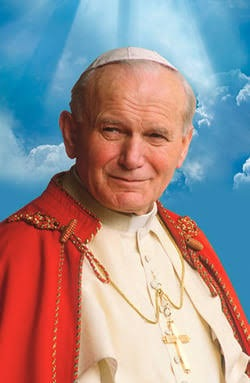
Feast Day: October 22
Let’s be honest: if a pope’s words can still echo in your head decades later, he probably did something right. Saint John Paul II was one of those rare figures whose presence seemed bigger than the stage he stood on. He was a shepherd, a philosopher, a missionary, a world traveler, and, above all, a man who kept pointing people back to Jesus Christ.
His famous words—“Do not be afraid”—were not just a nice slogan for bumper stickers and parish banners. They were a spiritual battle cry. And in a world that still wrestles with fear, confusion, suffering, and moral chaos, that message has lost exactly none of its power.
Few modern saints have left a mark on the Church like Saint John Paul II. For Catholics today, his life is more than a chapter in Church history. It is an invitation to trust Christ more deeply, defend human life more courageously, and live the faith with joy.
Born Karol Józef Wojtyła in Wadowice, Poland, on May 18, 1920, John Paul II grew up in a world marked by suffering. He lost his mother, brother, and father before becoming pope, and he lived through Nazi occupation and later communist rule. Those experiences shaped his understanding of human dignity, freedom, and the need for hope rooted in Christ.

A Life Shaped by Suffering and Faith
John Paul II was ordained a priest in 1946, became bishop of Kraków in 1958, a cardinal in 1967, and was elected pope on October 16, 1978. He took the name John Paul II and began one of the longest pontificates in history, lasting nearly 27 years.
That alone is impressive. But numbers only tell part of the story. The Vatican’s biographical profile notes that his pontificate included 14 encyclicals, 15 apostolic exhortations, 11 apostolic constitutions, and 45 apostolic letters. He also traveled extensively, bringing the Gospel to the world and making the papacy feel, in a very real sense, universal.
When he died on April 2, 2005, the Church mourned a spiritual father. He was canonized by Pope Francis on April 27, 2014.
His life reminds us of a deeply Catholic truth: suffering does not have the final word. As Saint Paul writes, “We know that all things work for good for those who love God” (Romans 8:28, NABRE).
Christ at the Center
If you want one theme that ties together John Paul II’s entire pontificate, it is this: Jesus Christ is the answer to the human heart. In his first encyclical, Redemptor Hominis, he placed Christ at the center of history and of every person’s life.
That may sound lofty, but it is deeply practical. If Christ is truly the center, then everything else starts to make sense: our dignity, our vocation, our suffering, our relationships, and even our fears.
Scripture fits beautifully here. Jesus says, “I am the way and the truth and the life” (John 14:6). And the Catechism teaches that Christ reveals man to himself and makes known the dignity of human beings created in God’s image (see CCC 1700–1706).
John Paul II constantly invited people to open their hearts to Jesus. His famous words, “Do not be afraid,” were not just a catchy phrase. They were a pastoral summons to trust in the Lord, even in uncertain times.
The Dignity of the Human Person
John Paul II’s teaching on the human person is one of his greatest gifts to the Church. He insisted that every person is loved by God, created for communion, and never to be treated as a mere object or tool.
That principle sounds simple until you start applying it. Then it becomes very demanding. It touches abortion, euthanasia, poverty, war, racism, exploitation, and every situation where a human being is reduced to a number, a problem, or a convenience.
In Evangelium Vitae, he defended the sacredness of human life from conception to natural death. The Catechism echoes this in its teaching that “human life must be respected and protected absolutely from the moment of conception” (CCC 2270).
Scripture gives us a strong foundation for this vision. In Psalm 139:13–16, the psalmist marvels that God formed him in the womb. Jeremiah 1:5 is just as striking: “Before I formed you in the womb I knew you.”
John Paul II saw in these texts not poetry alone, but revelation. Human dignity is not something society grants when it feels generous. It comes from God.

The Theology of the Body: A Vision of Love
One of John Paul II’s most famous contributions is what came to be known as the theology of the body. In a series of Wednesday audiences, he reflected on the meaning of the body, sexuality, marriage, and human love.
At first glance, that might sound like the sort of topic that belongs in a theology seminar or a very brave marriage prep class. But his message was actually refreshingly practical: the human body matters because the person matters.
Marriage is not just a social arrangement. It is a covenant of self-giving love. Human sexuality is not merely biological; it is ordered toward faithful love and плод (fruit/fetus)—well, let’s just say the Church takes the whole person seriously, body and soul.
His teaching harmonizes with Genesis 2:24 and Matthew 19:4–6, where Jesus affirms God’s plan for marriage. The Catechism develops these truths in its sections on marriage and sexuality, especially CCC 1601–1666 and CCC 2331–2379.
For Catholics trying to live chastely in a confused culture, John Paul II remains a powerful guide. He did not reduce love to feeling. He presented it as a call to self-gift, fidelity, and holiness.
Faith, Reason, and the Search for Truth
John Paul II also defended the harmony of faith and reason. In Fides et Ratio, he argued that truth is not the enemy of freedom but its foundation. That message is still needed today, especially in an age tempted by relativism—where “my truth” can sometimes mean “whatever I felt before coffee.”
Scripture supports this vision. Proverbs 2:6 says, “For the LORD gives wisdom; from his mouth come knowledge and understanding.” The Catechism likewise teaches that faith and reason are complementary, not opposed (see CCC 31–35, 156–159).
In other words, Catholics should not be afraid of hard questions. John Paul II believed the Gospel can withstand inquiry because all truth ultimately comes from God.
This is a liberating idea. You do not have to choose between being faithful and being thoughtful. In fact, Catholicism has always insisted that the deepest truths of reality make sense because they come from the same God.

The Eucharist, Mary, and the Rosary
John Paul II had deep Eucharistic devotion. In Ecclesia de Eucharistia, he called the Eucharist the center of ecclesial life, echoing what the Catechism teaches in CCC 1324: the Eucharist is “the source and summit of the Christian life.”
That’s not just pious language. It means the Mass is not one devotion among many. It is the heart of the Church’s life. If everything else in Catholic life were a house, the Eucharist would be the foundation, the beams, and the electrical wiring keeping the lights on.
He was also profoundly Marian. His motto, Totus Tuus (“Totally Yours”), showed his entrustment to the Blessed Virgin Mary. In Rosarium Virginis Mariae, he encouraged Catholics to pray the Rosary, and he even added the Luminous Mysteries to help the faithful meditate more deeply on Christ’s public ministry.
Mary always leads us to Jesus. That was John Paul II’s way, and it remains the Church’s way.
Why Saint John Paul II Still Matters
Saint John Paul II is not just admired; he is needed. His teaching speaks to families struggling to stay faithful, young people searching for purpose, and Catholics trying to hold onto truth in a noisy world.
He understood that modern people are not just looking for information. They are looking for meaning. And meaning is not something we invent. It is something we receive.
Here are a few takeaways from his life:
– Stay close to Christ
– Defend the dignity of every human life
– Live love as self-gift, not self-absorption
– Trust faith and reason together
– Pray the Rosary
– Make the Eucharist central
That list may be short, but it is not exactly a lightweight spiritual workout. Still, it is the kind of path that actually changes a life.
A Saint for Our Times
John Paul II’s canonization was not just a celebration of a beloved pope. It was the Church’s way of saying that holiness is possible in modern times. His life points us toward the universal call to holiness taught by Vatican II and reflected in the Catechism (CCC 2012–2016).
That matters because a lot of people assume sanctity is for monks, mystics, or people who can manage a spotless house and an uninterrupted prayer schedule. John Paul II reminds us otherwise. Holiness is for real people in real history, with real suffering, real responsibilities, and real grace.
If you want to grow in your Catholic faith, start where he always started: with Christ. Read the Gospels. Go to Confession. Receive the Eucharist. Pray the Rosary. And don’t be afraid to let Jesus change your life.
Saint John Paul II, pray for us.
Leave a Reply