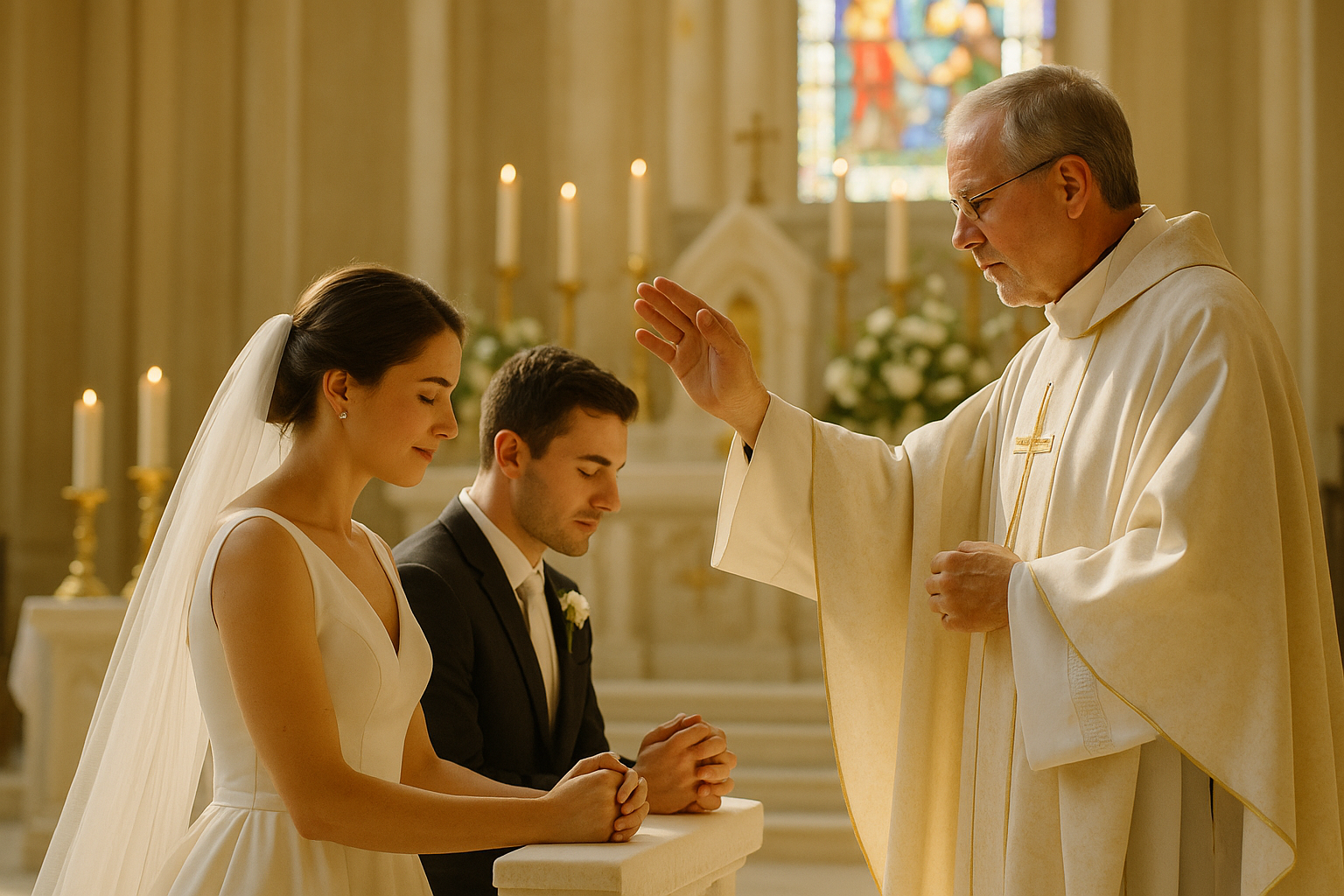
Let’s be honest: when most people hear Catholic marriage, their minds jump to the dress, the flowers, the music, and whether the reception will have enough food to survive the cousin who “forgot to eat lunch.” But Holy Matrimony is much bigger than a beautiful ceremony and a photo album that will live forever on grandma’s bookshelf.
For Catholics, marriage is a sacrament—one of the ways Christ actually gives grace. It is a lifelong covenant between one man and one woman, ordered toward the good of the spouses and the procreation and education of children. When both spouses are baptized, that covenant is raised by Christ to the dignity of a sacrament.
So, marriage is not merely a human arrangement or a romantic milestone. It is a living sign of something far greater: the faithful love between Christ and His Church.
What Is Holy Matrimony in the Catholic Church?
Here’s the short answer: Holy Matrimony is the sacrament by which a man and a woman give themselves to each other in a lifelong, faithful covenant, with God as witness and source of grace.
That’s the easy version. The Church’s version is a little more formal, but the heart of it is the same: marriage is about love, life, and holiness.
The Catechism of the Catholic Church says that the matrimonial covenant “by its nature is ordered toward the good of the spouses and the procreation and education of offspring” and, between baptized persons, “has been raised by Christ the Lord to the dignity of a sacrament” (CCC 1601).
That is classic Catholic teaching in one sentence.

God’s Plan from the Beginning
If you want to understand marriage, you have to go all the way back to Genesis. Right at the beginning of creation, God says, “It is not good for the man to be alone” (Gn 2:18, NABRE). Then comes one of the most famous lines in Scripture: “The two of them become one body” (Gn 2:24, NABRE).
That “one flesh” union is not a poetic afterthought. It is the foundation of Catholic teaching on marriage.
Marriage is part of God’s original design, not a cultural invention that humans came up with after a long committee meeting. Genesis 1:27–28 tells us that God created them “male and female” and told them, “Be fertile and multiply.” In other words, marriage is both unitive and fruitful. Husband and wife are called to love one another completely and to remain open to new life.
What Jesus Taught About Marriage
Now, before this starts sounding like a theology textbook, let’s look at what Jesus Himself said. And as usual, He does not make things smaller or softer—He makes them truer.
In Mark 10:6–9, Jesus points straight back to Genesis:
“From the beginning of creation, ‘God made them male and female.’ … So they are no longer two but one flesh. Therefore, what God has joined together, no human being must separate” (Mk 10:6–9, NABRE).
That line is at the heart of Catholic teaching on the indissolubility of marriage. In plain English: valid sacramental marriage is meant to last until death.
That is not because the Church enjoys being difficult. It is because marriage is meant to mirror God’s own faithful love. God does not do temporary fidelity. He does not say, “I love you until things get inconvenient.” Marriage is meant to reflect that same steadfastness.
Jesus also reveals something beautiful about marriage at the Wedding at Cana (Jn 2:1–11). His presence there matters. He attends the wedding, blesses the joy, and transforms the ordinary into something extraordinary. The Church has always seen Cana as a sign that Christ enters marriage not as a distant observer, but as the source of grace.
Marriage as a Sign of Christ and the Church
If you want the strongest New Testament teaching on Holy Matrimony, go to Ephesians 5:21–33. St. Paul compares the love of husband and wife to the love of Christ for the Church.
That is why Catholic marriage is a sacrament: it visibly points to an invisible reality.
A Christian husband is called to love his wife with sacrificial, self-giving love. A Christian wife is called to love her husband with mutual fidelity, respect, and care. This is not a contest for dominance, and it is certainly not a relic from some dusty ancient household manual. It is a call for two people to help one another get to heaven.
St. Augustine famously spoke of the “goods” of marriage: fidelity, children, and the sacramental bond. Those ideas still echo in Catholic teaching today. Marriage is about permanence, fruitfulness, and grace—three words that sound simple until you actually start living them.
What the Church Teaches About Holy Matrimony
The Catechism’s section on marriage, CCC 1601–1666, is the Church’s go-to guide for understanding this sacrament. A few key points stand out.
1. Marriage is a covenant
Marriage is more than a legal contract.
A contract says, “What do I get?”
A covenant says, “I give myself to you.”
That is a huge difference. Catholic marriage is a total, mutual, and irrevocable self-gift. It is not based on convenience or emotional luck. It is a promise rooted in love and sealed by grace.
2. Marriage has two essential purposes
Catholic teaching names two essential ends of marriage:
– the good of the spouses
– the procreation and education of children
These two purposes do not compete with one another. They belong together. A healthy Catholic understanding of marriage includes emotional unity, spiritual companionship, physical intimacy, and openness to life.
In other words, marriage is not only about “being happy together.” It is about becoming holy together.
3. Marriage is exclusive and permanent
Catholic marriage is one man and one woman in a faithful, lifelong union. As Jesus said, “What God has joined together, no human being must separate” (Mk 10:9, NABRE).
That exclusivity is not restrictive in a petty sense. It is protective. Love flourishes when it is faithful, total, and secure. Nobody builds a house on sand and then acts surprised when the floor gets weird.
4. Marriage gives grace
This is where the sacrament part really matters.
Marriage is not just a symbol of love. It is a true encounter with Christ. Through grace, He strengthens spouses to forgive, endure hardship, serve one another, and love with more than just human effort.
And thank goodness for that, because human effort alone tends to run out somewhere between “we need to talk” and “who left the milk out again?”
What Canon Law Protects
The Code of Canon Law reinforces this vision. Canon 1055 teaches that marriage is ordered toward the good of the spouses and the procreation and education of children, and that between baptized persons it is a sacrament.
Canon law also protects the freedom and seriousness of marriage by requiring true consent. No one can be forced into marriage, and no one can enter marriage without really intending what marriage is.
That matters more than people realize. The Church takes consent seriously because marriage is serious. A wedding is not just a nice event with vows read out loud. It is a real covenant made before God.
For Catholics, marriage is ordinarily celebrated before a priest or deacon and two witnesses, usually in a church. That is not merely tradition for tradition’s sake. It shows that marriage belongs to the life and worship of the Church.

Marriage in Daily Life
Holy Matrimony does not end when the reception band packs up and the cake is gone. In a very real sense, that is when the real work—and the real joy—begin.
Catholic spouses are called to live their vocation every day by:
– praying together
– forgiving quickly
– serving one another
– welcoming children generously
– raising children in the faith
– keeping Christ at the center of family life
This is why the family is often called the domestic church. The home becomes a place where faith is lived, taught, and shared. It is where children learn that grace is not just for Sundays, and where spouses learn that holiness often looks like patience, laundry, and choosing kindness when you are tired.
A Catholic marriage is not perfect. But it is meant to be holy.
Why Holy Matrimony Still Matters
In a world that often treats relationships as temporary, conditional, or disposable, Holy Matrimony offers a countercultural witness. It says that love is meant to be faithful, fruitful, and forever.
That witness matters because it tells the truth about human dignity, commitment, sacrifice, and hope. Marriage teaches us that real love is not just a feeling that comes and goes. It is a gift of self that endures.
And it points us toward heaven.
The Book of Revelation speaks of the “wedding feast of the Lamb” (Rev 19:7, 9, NABRE), which reminds us that earthly marriage is a sign of a deeper reality: the eternal union of Christ and His Church.
So, marriage is not just about finding the right person. It is also about becoming the right kind of person—someone capable of covenant love.
Final Thoughts
Holy Matrimony is a gift from God, a sign of Christ’s love, and a path to holiness. It calls spouses to unity, fidelity, openness to life, and daily conversion. For Catholics, marriage is one of the most powerful ways God sanctifies ordinary life.
If you are married, pray for the grace to love your spouse as Christ loves the Church. If you are preparing for marriage, study the sacrament carefully and let the Church guide you well. And if you are single, remember that marriage is one vocation among several, all of which are meant to lead us to sainthood.
For deeper reflection, read Genesis 2, Matthew 19, and Ephesians 5, and spend time with CCC 1601–1666. Holy Matrimony is not merely a ceremony—it is a covenant of love, a school of holiness, and a lifelong invitation to trust God.