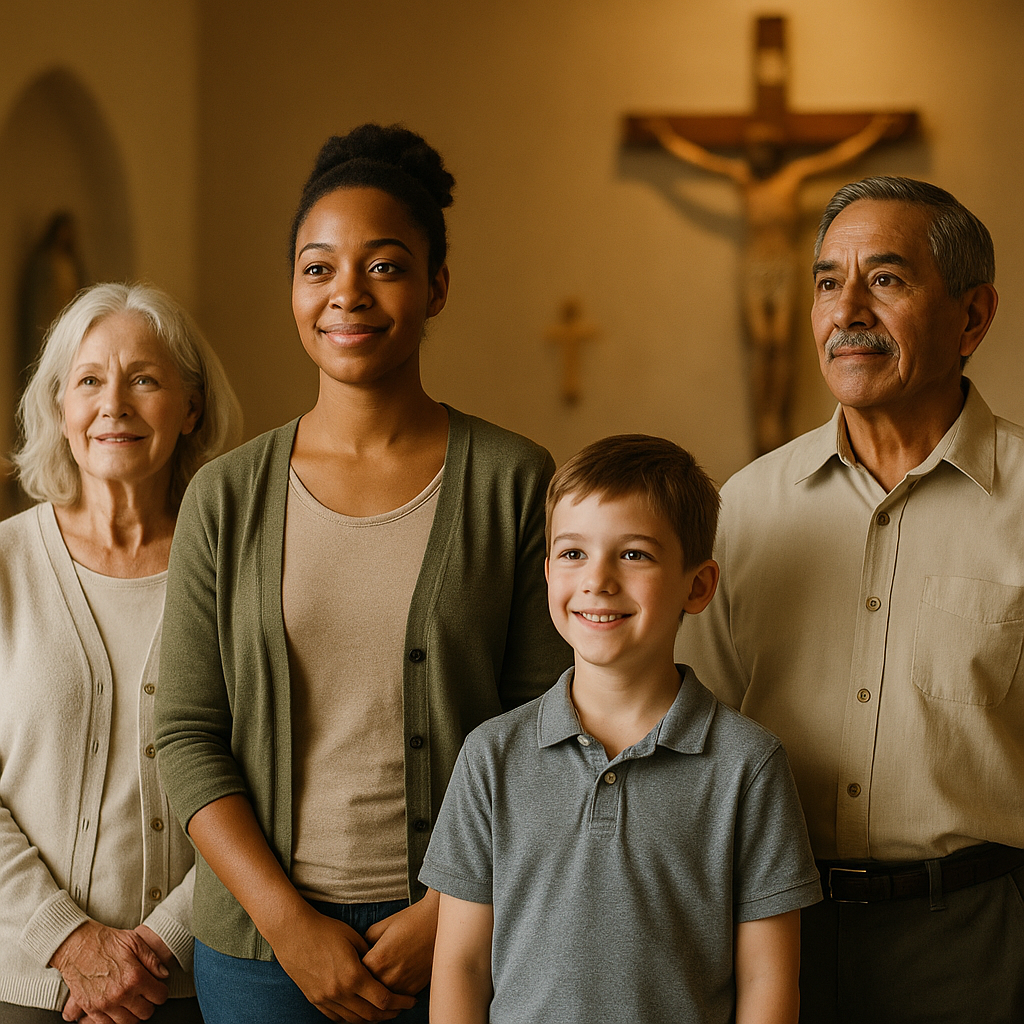
Let’s be honest: the word rights gets thrown around so often these days that it can start to sound like background noise. Everyone wants their rights respected—at school, at work, online, in politics, and yes, even in the parish hall where someone is definitely guarding the last donut like it’s a sacred relic.
But rights and responsibilities are not just a modern talking point. From a Catholic perspective, they are inseparable. If we want to understand human dignity, we have to ask a deeper question: What are rights for, and what do they require of us?
The Catholic answer is beautifully simple: every person is made in the image of God, so every person has dignity, and every dignity comes with duties toward others.

Human Dignity Comes First
The Catechism teaches, “Respect for the human person entails respect for the rights that flow from his dignity” (CCC 1930). That means rights are not invented by whichever group is loudest on social media this week. They flow from the fact that every human person has value because God gave that value.
Scripture says it right at the beginning: “God created mankind in his image” (Gn 1:27, NABRE). That one verse is not a decorative opening line. It is the foundation of Catholic social teaching.
If every person bears God’s image, then every person matters:
– the unborn child
– the elderly neighbor
– the refugee
– the disabled person
– the worker trying to make rent
– the prisoner
– the person who annoys you
– yes, even the person who votes differently than you
That does not mean we agree with everyone. It means we refuse to treat anyone as less than human.
This is also why the Church insists that the right to life is foundational. The U.S. bishops teach that human life is sacred from conception to natural death. Without the right to life, all other rights become shaky fast. A society that cannot protect the smallest and most vulnerable person is building on sand.
Human dignity is not earned. It is given by God.
Rights and Responsibilities Belong Together
Catholic teaching does not stop at rights. It always pairs them with responsibilities. The U.S. bishops’ social teaching emphasizes that human dignity can only be protected when human rights are respected and responsibilities are met. That means I have obligations not only to myself, but also to my family, my neighbors, and society.
This is where the Gospel gets very concrete. In Matthew 25:31–46, Jesus describes the Last Judgment. The Son of Man separates the sheep from the goats based on whether they fed the hungry, welcomed the stranger, cared for the sick, and visited the imprisoned.
Notice what is missing: nobody is praised for merely having correct opinions. They are judged by love in action.
That is the Catholic balance:
– I have rights
– Others have rights
– I have duties toward their good
– Society should help everyone flourish
Freedom, then, is not a license to do whatever I want. St. Paul says, “For freedom Christ set us free” but immediately warns against using that freedom selfishly; instead, we are to “serve one another through love” (Gal 5:1, 13, NABRE).
That’s a very Catholic sentence, really: true freedom is not doing whatever I feel like; it is doing what love requires.
Rights and responsibilities belong together. If one is missing, the picture is incomplete.

The Common Good: More Than Me and Mine
One of the most important Catholic principles here is the common good. The Catechism defines it as “the sum total of social conditions which allow people, either as groups or as individuals, to reach their fulfillment more fully and more easily” (CCC 1906).
That sounds a little formal, but it is actually very practical. The common good means a society should be ordered so people can truly flourish. That includes:
– fair laws
– safe communities
– honest wages
– access to education and health care
– protection for the vulnerable
– peace instead of chaos
St. Paul says it beautifully: “Let each of you look not to his own interests, but also to those of others” (Phil 2:4, NABRE). And in another place he reminds us that if one member suffers, all suffer together (cf. 1 Cor 12:26, NABRE). Catholic life is not a solo project. We are members of one body.
Now, before this starts sounding like a civics lecture with incense, here’s the practical point: the common good is what makes a society livable. If only the strong thrive, something is broken. If only the rich are heard, something is broken. If only the loud get protected, something is broken.
The Church’s vision is bigger and more human than that.
Solidarity and Subsidiarity: Two Catholic Balances
Catholic social teaching gives us two very helpful words that sound technical but are actually deeply human: solidarity and subsidiarity.
Solidarity
Solidarity means we are one human family. We do not get to say, “That’s not my problem.” The Good Samaritan in Luke 10:25–37 is the model here. He sees the wounded man, stops, and acts.
That’s solidarity:
– noticing suffering
– refusing indifference
– stepping in when help is needed
– recognizing that another person’s pain matters to me
Solidarity is not just a vague feeling of kindness. It is the conviction that your neighbor is not a project, a nuisance, or a political talking point. He is a brother or sister.
Subsidiarity
Subsidiarity means higher levels of society should help, not swallow up, smaller ones. The family comes first, then local communities, then larger institutions. A healthy society supports families instead of replacing them. It helps people do what they can do for themselves.
This principle is one reason the Church strongly defends the family as the “vital cell” of society. Parents have the primary right and duty to raise and educate their children. Children, in turn, owe honor and care to their parents.
That is not old-fashioned. It is deeply human.
A society that ignores subsidiarity often ends up doing one of two things:
1. burdening families with impossible expectations, or
2. taking over responsibilities that belong closer to home.
Neither is good. The Church’s vision is balanced, realistic, and rooted in the dignity of the person.

Rights That Flow from Dignity
Catholic teaching regularly identifies several basic rights that flow from human dignity:
– the right to life
– the right to religious freedom
– the right to work and a just wage
– the right to food, shelter, education, and health care
– the right to marry and form a family
– the right to participate in society
These are not luxury rights for the fortunate few. They are part of what justice requires.
That does not mean every society solves them perfectly at once—human beings are involved, after all, and that usually complicates things. But it does mean we should never accept a world where the vulnerable are treated as inconvenient or invisible.
St. John writes, “If someone who has worldly means sees a brother or sister in need and refuses him compassion, how can the love of God remain in him?” (1 Jn 3:17, NABRE). That is a bracing question.
Catholic teaching says rights are real, but they are never detached from the moral law or from the dignity of others. My rights do not cancel your rights. My freedom does not erase your humanity.
Duties Toward Family, Society, and the Poor
So what are our responsibilities?
To God
We are called to worship Him, obey His commandments, and seek holiness. This is the first duty because everything else flows from it.
To family
We are called to love, protect, educate, and support one another. That includes patience, sacrifice, and sometimes the heroic virtue of listening without interrupting.
To neighbors
We are called to practice justice, mercy, and truth. Not just when it is convenient, and not only when we feel like the moral high ground is especially photogenic.
To society
We are called to vote responsibly, tell the truth, work honestly, and defend the common good. Catholics do not check faith at the door when entering civic life.
To the poor and vulnerable
We are called to serve generously and refuse indifference. The corporal works of mercy are not decorative extras; they are part of the Christian life.
These duties are not burdens meant to crush us. They are the path to authentic freedom. We become most fully ourselves when we love as Christ loves.
Living Catholic Rights and Responsibilities Today
In everyday life, this teaching asks something simple and demanding:
– Do I defend life, even when it is unpopular?
– Do I respect the dignity of people I disagree with?
– Do I treat workers fairly?
– Do I support my family faithfully?
– Do I care about the poor, the lonely, and the forgotten?
– Do I use my freedom for love or just for convenience?
Those are not easy questions, and that is exactly why they matter.
Catholic teaching is not meant to make us anxious. It is meant to make us holy. The goal is not to win every argument with a perfectly sharpened quote from a document nobody has actually read all the way through. The goal is to become more like Christ.
And Christ did not love in theory. He loved in action:
– He healed
– He fed
– He forgave
– He welcomed
– He laid down His life
That is the pattern for Catholic social life too.
Final Thoughts
Catholic teaching on rights and responsibilities reminds us that dignity is not a slogan. It is a calling.
Every person matters. Every person has rights. And every person has duties toward the good of others.
If we take that seriously, families grow stronger, communities become healthier, and society becomes more human. That is the Catholic vision: not just defending what is mine, but building a world where the dignity of everyone is respected.
Take a few minutes today to pray with Genesis 1:27, Matthew 25:31–46, and Philippians 2:4. Then ask the Lord:
How am I called to respect the rights of others and fulfill my responsibilities with love?