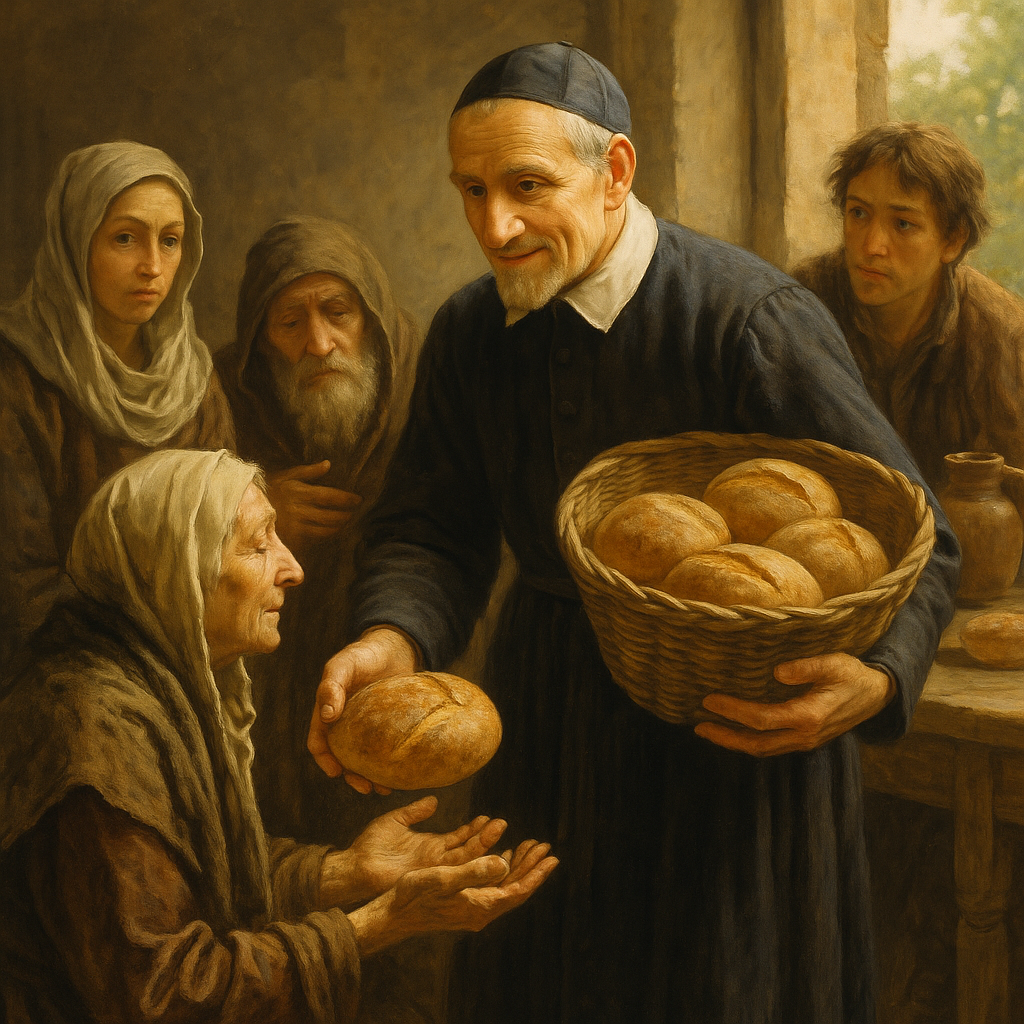
If you’ve ever seen a St. Vincent de Paul food pantry, a Vincentian parish mission, or the Society of St. Vincent de Paul helping a family pay rent, you’ve already met one of the Church’s great saints of mercy. St. Vincent de Paul didn’t just encourage kindness. He helped Catholics see that charity is not a one-time act, but a lifelong mission shaped by prayer, humility, and love of Christ.
His story is a reminder that holiness is not abstract. It has receipts, soup pots, home visits, seminary reform, and a lot of hard work. And yes, a saint can absolutely change the world without becoming a walking theology textbook.

Who Was St. Vincent de Paul?
St. Vincent de Paul was born in 1581 in Pouy, France, and ordained a priest in 1600. Like many saints, his path was not perfectly straight. Early in his priesthood, he experienced uncertainty, hardship, and a few plot twists that would make any modern résumé look dramatic.
But God has a habit of turning detours into destinies.
Over time, Vincent was drawn into a deeper love for the poor and a stronger desire to renew the priesthood. A major turning point came in 1617 through his experiences in Folleville and Châtillon-les-Dombes. In one well-known incident, a parishioner told him about a family in desperate need. Vincent preached about their situation, and the response was overwhelming. But the help was disorganized. That moment helped him see something crucial: charity needs structure if it is going to last.
From that insight grew a movement.
St. Vincent de Paul and the Works of Charity
Vincent’s legacy includes several major Catholic institutions that still serve the Church today.
The Confraternities of Charity
These were groups of laypeople organized to care for the poor, sick, and abandoned. In many ways, they were an early model of organized Catholic lay service. In other words, Vincent understood that helping others was not only for “professionals” or holy superstars. Regular Catholics could and should be part of the mission.
The Congregation of the Mission
Founded to preach missions, renew the clergy, and evangelize the poor, this community became known as the Vincentians or Lazarists. Their work focused on practical evangelization and solid priestly formation.
Vincent knew something many of us quietly need to hear: if the shepherds are exhausted, unformed, or spiritually dry, the sheep notice. A lot.
The Daughters of Charity
Founded with St. Louise de Marillac in 1633, the Daughters of Charity brought a new kind of active religious life to the Church. Instead of living enclosed lives, they went directly to those in need: the sick, prisoners, orphans, and wounded.
That was pretty radical for the time. But holiness often looks radical when it is simply taking the Gospel seriously.

Priestly Formation
Vincent also helped shape the future of the priesthood by promoting retreats, seminaries, and better formation. He knew that the Church’s mission to the poor required holy, well-formed priests.
That’s still true. A saintly priesthood doesn’t just happen by accident, and neither does a healthy parish.
His Spirituality: Charity with a Heart
What made Vincent de Paul so powerful was not just what he did, but how he thought about Christian love.
He Saw Christ in the Poor
Vincent’s approach is rooted in the Gospel, especially Matthew 25:31–46, where Jesus says:
“Whatever you did for one of these least brothers of mine, you did for me” (Mt 25:40, NABRE).
That verse is basically the engine of Vincentian spirituality. The poor are not a project. They are a place of encounter with Christ.
And that changes everything. If Christ is present in the poor, then mercy is not merely a good deed. It becomes sacred ground.
He Believed Love Must Become Action
A key Vincentian saying, preserved in Church tradition, teaches that love for God cannot remain empty or inactive; it must lead us to help others. That lines up beautifully with 1 John 3:18:
“Children, let us love not in word or speech but in deed and truth” (1 Jn 3:18, NABRE).
For Vincent, charity was never just a feeling. It was something you could see, touch, organize, and sustain.
Let’s be honest: it’s easy to feel compassionate for three minutes while scrolling online. It’s much harder to show up, follow through, and keep helping when the work is messy or repetitive. Vincent understood that love has to be embodied if it’s going to mean anything.
He Loved Humility and Simplicity
Vincentian spirituality emphasizes humility, simplicity, gentleness, and practical compassion. He did not want Christians to “perform” charity in a self-congratulatory way. He wanted them to serve with reverence, sincerity, and realism.
That’s a useful reminder for all of us. It’s easy to love “humanity” in general. It’s harder to love the actual person in front of us, especially when that person is inconvenient, messy, or complicated. Charity becomes real when the person in need has a name, a face, and a story.

A Saint for the Church’s Social Mission
The Catechism of the Catholic Church teaches the corporal works of mercy—feeding the hungry, sheltering the homeless, visiting the sick and imprisoned, and more—as essential expressions of Christian life. That fits Vincent perfectly.
Relevant Catechism themes include:
– charity as the greatest virtue
– solidarity with those in need
– the preferential love for the poor
– the dignity of every human person
– the call of all Christians to holiness
You could say Vincent took those teachings and made them concrete. He didn’t just talk about mercy. He built a system that made mercy possible.
And that’s one of the great lessons here: Catholic social teaching is not meant to stay on the page looking noble. It is meant to become soup kitchens, home visits, aid, listening ears, and practical help.
Scripture That Fits St. Vincent de Paul
If you want to understand Vincent’s life, these passages are especially helpful:
Matthew 25:31–46
Jesus identifies himself with the hungry, thirsty, sick, stranger, and imprisoned.
Luke 4:16–21
Jesus announces good news to the poor and freedom for the oppressed.
Luke 10:25–37
The Good Samaritan doesn’t pass by. He stops, tends wounds, and arranges care.
Acts 4:32–35
The early Church shares possessions so that no one is in need.
James 2:14–17
Faith without works is dead.
Vincentian charity is basically the Gospel with work boots on.
Why St. Vincent de Paul Still Matters
St. Vincent de Paul was canonized in 1737 by Pope Clement XII and later named patron of charitable works. His feast day is September 27, and the Church still honors him as a model of priestly zeal and practical love.
His relevance today is obvious. Poverty still exists. So do loneliness, homelessness, addiction, joblessness, and family instability. Vincent’s example teaches us several important lessons:
1. Serve people personally.
Charity should involve presence, listening, and dignity.
2. Organize mercy.
Good intentions are not enough; structures matter.
3. Link service and evangelization.
People need bread, yes—but also hope, truth, and the Gospel.
4. Work with the whole Church.
Laypeople, religious, and clergy all have a role.
5. Respect the poor as brothers and sisters.
They are not “cases.” They are people loved by God.
That last point is especially important. It is very Catholic to insist that every person is sacred, not because of what they produce, but because of who made them.
The Vincentian Legacy Today
The Society of St. Vincent de Paul, founded after Vincent’s death, continues his mission through home visits, food assistance, housing help, disaster relief, and person-to-person service. That’s one of the clearest signs that Vincent’s charism is still alive.
Pope Francis, in a message to the Vincentian Family, praised this legacy and connected it to the early Christian community in Acts 4:32. In other words, Vincent’s vision isn’t just historical. It’s deeply biblical and very current.
That matters because the Church never runs out of people in need. And if we’re honest, the Church never runs out of people who need to be reminded that charity is not a side hobby for especially kind Catholics. It’s central to the Christian life.
Final Takeaway
St. Vincent de Paul shows us that holiness is not only about prayer in church, but also about mercy in motion. He reminds Catholics that love of God must spill over into love of neighbor, especially the poor.
If you want to live more like St. Vincent, start small:
– pray for the poor
– support a local charity
– volunteer with a parish outreach
– read Matthew 25
– and ask Christ to make your heart more generous
After all, Vincent’s life proves that one saint, surrendered to God, can change the whole way the Church serves the world.