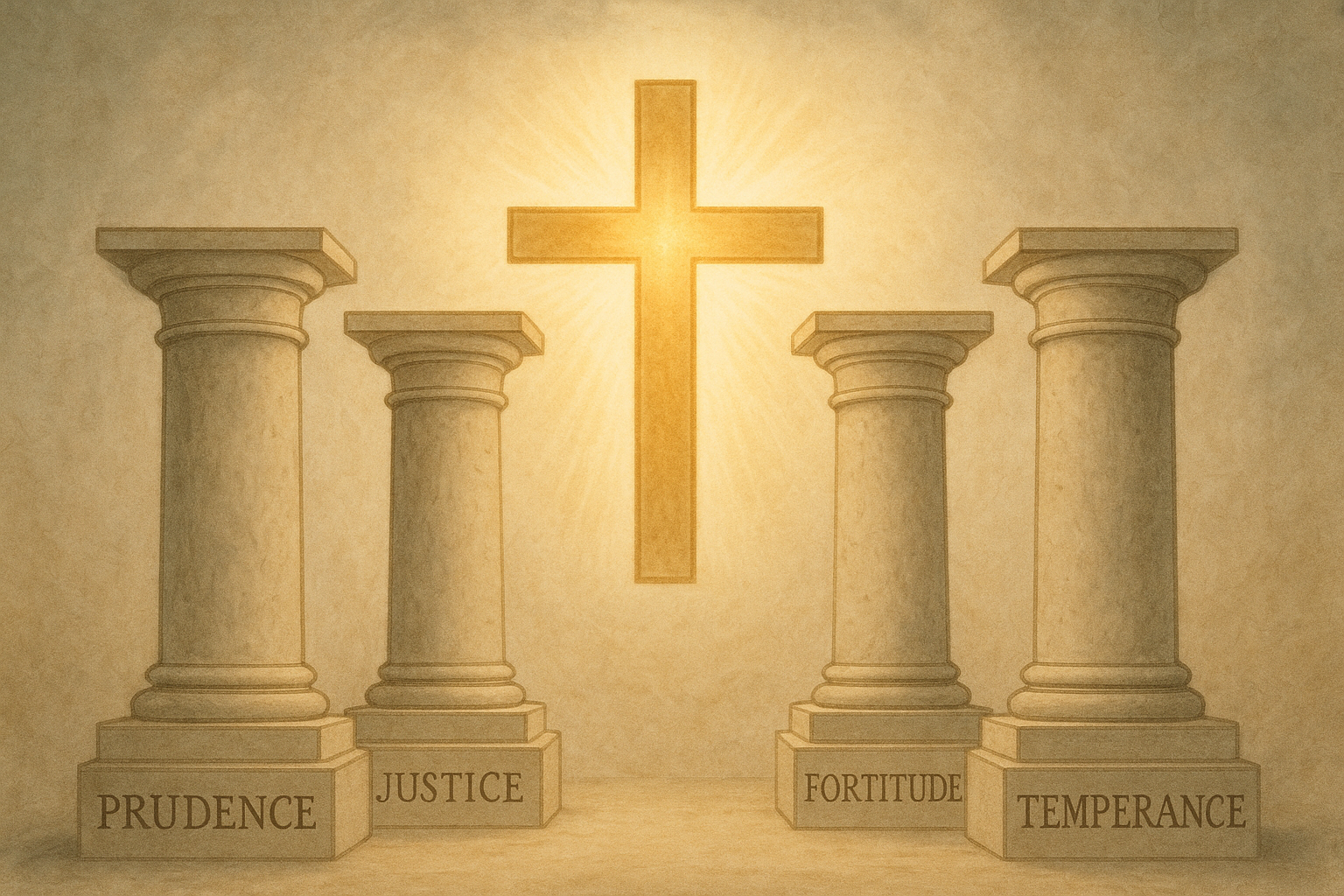
If you’ve ever tried to build a strong habit—prayer, patience, self-control, honesty—you already know this: character doesn’t happen by accident. In Catholic teaching, the cardinal virtues are the sturdy hinges that help the whole moral life turn in the right direction. They are prudence, justice, fortitude, and temperance—and they matter because they shape everyday holiness, not just mountaintop spiritual moments.
The Catechism of the Catholic Church explains that these virtues are “firm attitudes, stable dispositions, habitual perfections of intellect and will” that guide our actions according to reason and faith (CCC 1804). In other words, they are not vague ideals. They are habits of soul that help Catholics make good choices, love rightly, and persevere when life gets messy.
What Does “Cardinal” Mean?
The word cardinal comes from the Latin cardo, meaning “hinge.” Like a door that swings on a hinge, many other moral virtues depend on these four. According to the Catechism, “Four virtues play a pivotal role and accordingly are called ‘cardinal’; all the others are grouped around them” (CCC 1805).
That’s a beautiful image. If prudence, justice, fortitude, and temperance are strong, the rest of the moral life tends to swing more smoothly. If they’re weak, everything starts squeaking. And nobody wants a squeaky soul.
Now before this starts sounding like a home DYI project, let’s walk through each one in plain English.

The Four Cardinal Virtues
Prudence: Knowing What to Do and When
Prudence is often misunderstood as mere caution or “playing it safe.” But Catholic teaching gives it a much richer meaning. CCC 1806 says prudence is the virtue that disposes practical reason to discern our true good in every circumstance and to choose the right means of achieving it.
Prudence is not fear. It is wise, Spirit-led judgment. It asks:
– What is the good here?
– What does God want?
– What is the best way to do this?
Scripture praises this kind of wisdom. “Trust in the LORD with all your heart, on your own intelligence do not rely” (Proverbs 3:5–6, NABRE). And in Wisdom 8:7, the inspired text even names the virtues together: wisdom “teaches temperance and prudence, justice and fortitude.”
In daily life, prudence helps with everything from choosing friendships to handling money to deciding whether that text message really needs an immediate reply. Sometimes holiness looks less like a thunderbolt and more like taking a breath before responding.
Justice: Giving God and Neighbor Their Due
Justice is the virtue of giving each person what is owed. CCC 1807 defines it as “the constant and firm will to give their due to God and neighbor.”
This includes:
– worshiping God faithfully
– respecting the dignity of others
– being honest in speech and action
– working for the common good
The prophet Micah sums it up well: “You have been told, O mortal, what is good, and what the LORD requires of you: Only to do justice and to love goodness, and to walk humbly with your God” (Micah 6:8, NABRE).
Justice is not just for judges or lawyers. It shows up when we pay fair wages, keep promises, tell the truth, and treat people fairly even when no one is watching. It also means we render to God what belongs to Him: worship, obedience, gratitude, and love.
Here’s the thing: justice is deeply practical. A Catholic can’t say “I love God” while living carelessly toward neighbor. The two belong together like prayer and action, or coffee and a Monday morning parish volunteer shift.
Fortitude: Staying Strong When Life Is Hard
Fortitude is courage with stamina. CCC 1808 says it is the virtue that ensures firmness in difficulties and constancy in the pursuit of the good.
This virtue matters because doing the right thing is not always easy. Sometimes it is unpopular, inconvenient, or painful. Fortitude helps us keep going.
Scripture is full of this kind of encouragement: “Be strong and steadfast. Do not fear nor be dismayed, for the LORD, your God, is with you wherever you go” (Joshua 1:9, NABRE). St. Paul also tells the Corinthians, “Be on your guard, stand firm in the faith, be courageous, be strong” (1 Corinthians 16:13, NABRE).
Fortitude is what helps a Catholic:
– remain faithful in suffering
– resist pressure to compromise
– keep praying when prayer feels dry
– endure trials without losing hope
It’s not about being dramatic. It’s about staying faithful. Quiet perseverance is often more heroic than the loud kind. The saint in the pew may not look flashy, but they are fighting a real battle.
Temperance: Ordering Our Desires
Temperance is the virtue of self-mastery. CCC 1809 says it moderates the attraction of pleasures and provides balance in the use of created goods.
This is where Catholicism gets very practical. Temperance helps us enjoy good things without being ruled by them. Food, drink, entertainment, social media, shopping, even work—none of these are bad in themselves. But without temperance, they can start to run the show.
St. Paul uses athletic imagery to describe this discipline: “Every athlete exercises discipline in every way” (1 Corinthians 9:25, NABRE). He also writes that the grace of God trains us “to live temperately, justly, and devoutly in this age” (Titus 2:12, NABRE).
Temperance is not anti-joy. It’s what makes real joy possible, because it keeps desire in its proper place. A person who is mastered by impulse is not actually free. A person who is ordered in desire is.
And yes, this applies to dessert too. The Church is not against pie. She is just suspicious of the second slice when the first one has already launched a negotiation with your conscience.
A Brief Catholic History of the Virtues
The cardinal virtues have deep roots in the Christian tradition. Early Church Fathers such as St. Ambrose and St. Augustine drew on classical moral philosophy and brought these virtues into the Christian moral vision. Later, St. Thomas Aquinas explained that they are the “hinges” of moral life, with other virtues flowing from or around them.
For Aquinas, prudence belongs to reason, justice to the will, fortitude to the irascible appetite, and temperance to the concupiscible appetite. That may sound technical, but the point is simple: the whole person is meant to be ordered toward the good.
And for Christians, these virtues are not merely human self-improvement. Grace heals and elevates them. As the Catechism teaches, God’s grace is needed to strengthen and perfect the moral life (CCC 1810–1811).
That’s an important Catholic balance. We do not become virtuous by sheer willpower alone, like spiritual bodybuilders flexing in front of a mirror. We cooperate with grace. God acts first; we respond.

How the Cardinal Virtues Work Together
These four virtues are not separate boxes on a checklist. They work as a team.
– Prudence tells you what to do.
– Justice tells you to whom it is owed.
– Fortitude gives you the strength to do it.
– Temperance keeps your desires from dragging you off course.
Without prudence, justice can become rigid.
Without justice, fortitude can become selfish.
Without fortitude, prudence stays theoretical.
Without temperance, all the rest can get hijacked by appetite.
So yes, they are “hinges,” but they are also companions. A strong moral life needs all four moving together.
Living the Cardinal Virtues Today
Here’s the good news: the cardinal virtues are not only for theology books. They’re for real life.
Try these simple practices:
– Prudence: pause before major decisions and pray, “Lord, show me the good.”
– Justice: examine whether your work, speech, and relationships honor others’ dignity.
– Fortitude: choose one faithful act you can do even when it’s hard.
– Temperance: practice modesty with food, screen time, or spending.
You could also do a quick nightly examen:
– Where did I act wisely today?
– Where did I fail to give someone their due?
– Where did I need courage?
– Where did I let desire run ahead of reason?
Small choices matter. Virtue grows through repeated acts, not instant perfection. Thankfully, God is patient. He is very much in the business of forming souls over time.
Final Thoughts
The four cardinal virtues—prudence, justice, fortitude, and temperance—are foundational to the Catholic moral life. They help us think wisely, act fairly, endure bravely, and desire rightly. More than that, they prepare the soul to receive and cooperate with God’s grace.
If you want to grow in holiness, start here. Ask the Lord to form these virtues in you, and keep practicing them in daily life. Read Scripture. Study the Catechism. Go to confession. Receive the Eucharist. And don’t underestimate the holiness of small, faithful choices.
A strong Christian life is built one virtue at a time.
FAQ: Cardinal Virtues and Catholic Life
Are the cardinal virtues the same as the theological virtues?
No. The cardinal virtues are prudence, justice, fortitude, and temperance. The theological virtues are faith, hope, and charity. The theological virtues orient us directly toward God, while the cardinal virtues help order our moral life.
Why are the cardinal virtues important in everyday life?
Because most moral decisions happen in ordinary moments: how we speak, spend, pray, forgive, work, and respond under stress. The cardinal virtues help shape those daily choices.
Can someone grow in virtue gradually?
Yes. In fact, that is usually how it works. Virtue is formed through repeated acts, grace, prayer, and sacramental life. No one becomes patient, brave, or self-controlled overnight—except maybe in a miracle, and even then God tends to keep us humble.