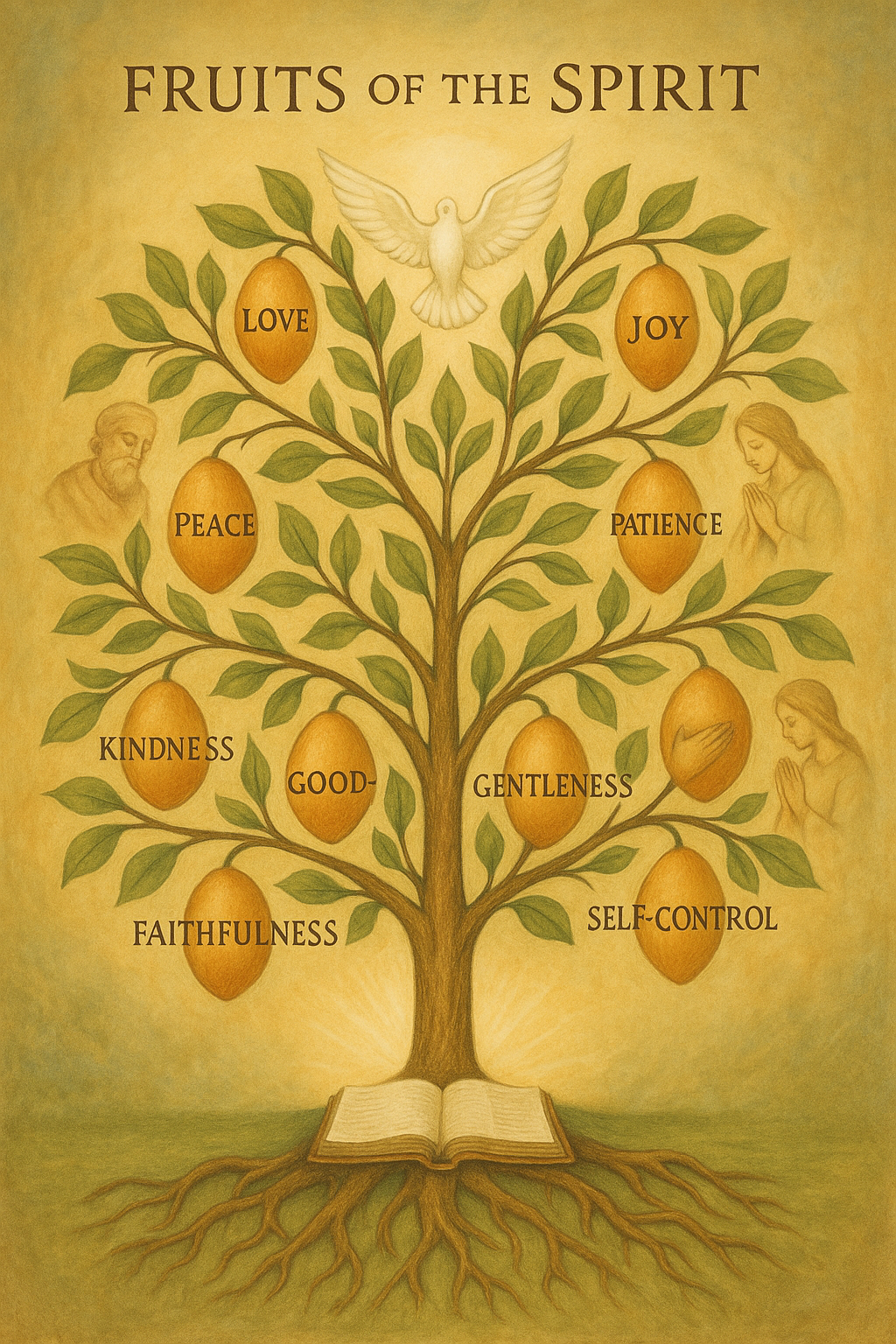
Ever wonder what a spiritually healthy Catholic life actually looks like? It’s not just about saying the right prayers, keeping your Sunday obligation, and trying not to lose your patience in the parish parking lot. According to Scripture and the Church, a life led by the Holy Spirit begins to show something beautiful and unmistakable: the fruits of the Holy Spirit. These are not spiritual trophies for the “super-Catholics.” They are the visible signs that grace is changing a person from the inside out.
What Are the Fruits of the Holy Spirit?
The fruits of the Holy Spirit are the visible signs that the Holy Spirit is at work in a person’s life. In other words, when we cooperate with grace, our character starts to look more like Christ.
St. Paul gives us the classic list in Galatians 5:22–23 (NABRE):
“In contrast, the fruit of the Spirit is love, joy, peace, patience, kindness, generosity, faithfulness, gentleness, self-control. Against such there is no law.”
Paul is contrasting the works of the flesh with the life of the Spirit. When a person lives close to Christ, the Holy Spirit begins to produce real, visible transformation.
The Catechism of the Catholic Church explains it this way:
“The fruits of the Spirit are perfections that the Holy Spirit forms in us as the first fruits of eternal glory” (CCC 1832).
That’s a beautiful phrase: first fruits of eternal glory. The fruits of the Spirit are like a little preview of heaven breaking into ordinary Tuesday life.

The 12 Fruits of the Holy Spirit in Catholic Tradition
The Church traditionally speaks of twelve fruits of the Holy Spirit, expanding on St. Paul’s list:
1. Charity
2. Joy
3. Peace
4. Patience
5. Kindness
6. Goodness
7. Generosity
8. Gentleness
9. Faithfulness
10. Modesty
11. Self-control
12. Chastity
This does not contradict Scripture. Rather, it reflects how Catholic tradition has prayed over and reflected on Paul’s teaching for centuries.
A good way to think about it: Scripture gives the foundation, and the Church helps us notice the furniture.
Gifts and Fruits of the Holy Spirit: What’s the Difference?
People often mix up the gifts and fruits of the Holy Spirit, so let’s make it simple.
The gifts of the Holy Spirit
The seven gifts are listed in CCC 1831:
– wisdom
– understanding
– counsel
– fortitude
– knowledge
– piety
– fear of the Lord
These are supernatural helps that make us more responsive to God.
The fruits of the Holy Spirit
The fruits are the results of those gifts at work in us. If the gifts are the Spirit’s inner help, the fruits are the outward evidence. In plain English: the gifts are what God gives; the fruits are what other people start to notice.

A Closer Look at the Fruits
Here’s a practical look at what each fruit means in everyday Catholic life:
– Charity: supernatural love of God and neighbor
– Joy: deep gladness rooted in God, not circumstances
– Peace: interior calm that comes from trusting God
– Patience: steady endurance without constant complaining
– Kindness: a gentle, considerate spirit
– Goodness: a habit of doing what is right
– Generosity: giving freely of time, talent, and treasure
– Gentleness: strength under control, not harshness
– Faithfulness: loyalty to God, your promises, and your vocation
– Modesty: humility in speech, dress, and behavior
– Self-control: discipline over desires and impulses
– Chastity: purity and integration of sexuality according to one’s state in life
These fruits are not just “nice personality traits.” They are signs that the Holy Spirit is healing and elevating the human heart.
And yes, they absolutely show up in the small stuff: how you answer your spouse, how you treat the slow cashier, how you react when your plans get interrupted, and whether your “patience” survives the third email that says, “Just following up…”
Why the Fruits of the Holy Spirit Matter
The fruits of the Holy Spirit matter because they reveal what kind of life we are really living. It’s easy to say we belong to Christ. It’s another thing entirely when our homes, conversations, habits, and relationships begin to look like His.
If our faith is real, it should bear fruit:
– in our families
– in our parishes
– in our friendships
– in our work
– even in the way we handle stress and conflict
The Holy Spirit does not just make us “better behaved.” He makes us more like Christ.
That’s the real goal of Catholic life: not merely to be polished, but to be transformed.

How Do We Grow in the Fruits of the Holy Spirit?
Good news: you do not have to manufacture these fruits through sheer willpower. The Holy Spirit produces them in us as we cooperate with grace. That means the Christian life is not a solo project.
1. Stay close to Jesus
In John 15:5, Jesus says, “Whoever remains in me and I in him will bear much fruit, because without me you can do nothing.”
That’s the whole secret right there.
The more we remain in Christ through prayer, Scripture, and obedience, the more fruit will grow.
A Catholic life disconnected from Jesus is like trying to grow grapes in a pantry. Technically, something is happening—but it’s probably not fruit.
2. Live the sacramental life
The sacraments are not optional extras; they are ordinary ways God gives grace.
– The Eucharist unites us to Christ, the true vine.
– Confession removes sin that blocks spiritual growth and restores us to grace.
A Catholic who wants to grow in the fruits of the Spirit should take the sacraments seriously. They are not spiritual hobbies. They are life.
The more we receive grace, the more the Spirit can shape us from the inside out.
3. Practice small acts of virtue
The fruits grow through ordinary choices:
– Choose patience when you’re interrupted.
– Choose gentleness when you’re irritated.
– Choose generosity when it would be easier to hold back.
– Choose self-control when no one is watching.
Holiness usually looks less like fireworks and more like faithful repetition.
That’s not flashy, but it works. Grace loves consistency.
4. Pray to the Holy Spirit
A simple prayer can go a long way:
“Come, Holy Spirit, and form in me the fruits of your presence.”
You might also ask for one specific fruit each day. For example:
– Monday: joy
– Tuesday: patience
– Wednesday: self-control
Tiny prayer, huge impact.
This is a great way to make the work of sanctification feel concrete instead of vague. You do not need a dramatic spiritual monologue. Sometimes you just need a sincere “Come, Holy Spirit” before breakfast.
5. Examine your conscience daily
At the end of the day, ask:
– Where did I see the fruits of the Spirit today?
– Where did I give in to the works of the flesh?
– What needs to change tomorrow?
This kind of reflection helps us notice whether we are truly walking by the Spirit.
It also keeps us honest. We all have blind spots, and the conscience is a mercy, not a buzzkill.
How to Tell If the Holy Spirit Is at Work in You
A good question to ask is not, “Do I feel spiritually impressive?” That’s usually a trap. A better question is:
Am I becoming more loving, more peaceful, more patient, more faithful, and more self-controlled?
That’s the real test.
The Holy Spirit often works quietly. He may not announce Himself with thunder and special effects. More often, He shows up in the slow reordering of the heart:
– less resentment
– more gratitude
– less anxiety
– more trust
– less impulse
– more discipline
That’s fruit.

Why the Fruits Are a Sign of Hope
The fruits of the Holy Spirit matter because they are signs that grace is already at work. You do not have to wait until you are “spiritually advanced” to begin bearing fruit. The Lord is patient, and He grows saints the way He grows good things: steadily, faithfully, and often under the surface first.
That means even a small step toward peace, gentleness, or self-control is not meaningless. It is evidence that God is working in you.
And that is very good news for the rest of us.
Final Thoughts
The fruits of the Holy Spirit are not a checklist to conquer, but a grace-filled way of life to receive. They are what happen when a Catholic stays close to Jesus, cooperates with grace, and lets the Holy Spirit do His work.
So if you want more love, joy, peace, patience, and the rest, start where the Church always starts: prayer, the sacraments, Scripture, and daily conversion. Ask the Holy Spirit to shape your heart, and trust that He will.
The goal of the Christian life is not simply to avoid sin. It is to become a person whose life tastes like heaven.
If you’d like, spend a few minutes today with Galatians 5:22–23, then ask: Which fruit of the Spirit is God inviting me to grow in right now?