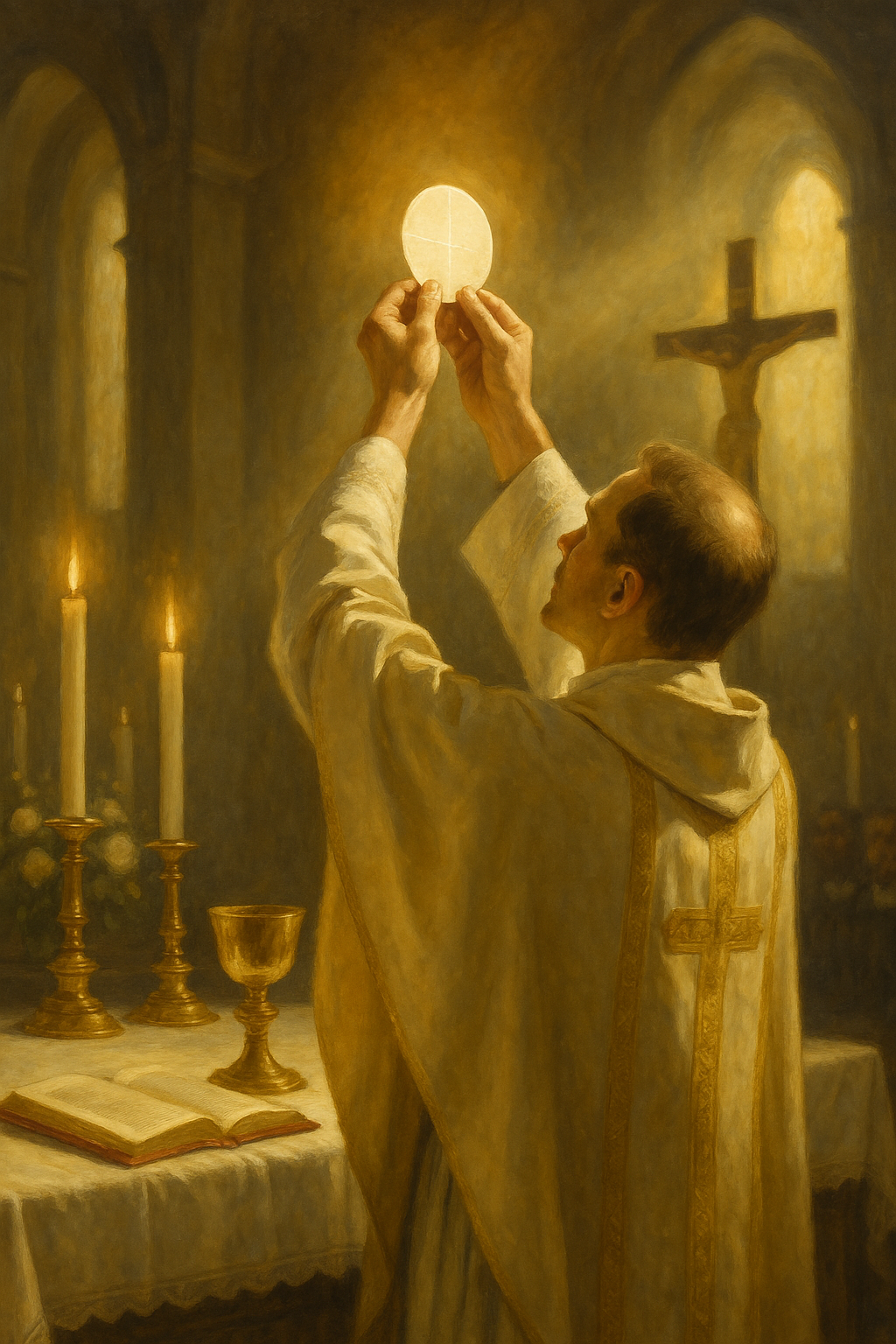
Let’s be honest: if you tell someone, “Catholics believe the Eucharist is Jesus,” you’ll usually get one of three reactions. Confusion. Skepticism. Or that polite little smile people use when they think you’ve wandered into medieval fantasy land.
But the Catholic claim is not that the Eucharist is like Jesus in a vague, inspirational sense. The claim is that after the consecration at Mass, Jesus Christ is truly present—Body, Blood, Soul, and Divinity—under the appearances of bread and wine. That is not a side hobby of Catholicism. That is the beating heart of it.

What the Church Means by “Real Presence”
The Church teaches that in the Eucharist, Christ is present “truly, really, and substantially” (CCC 1374). That phrase is doing a lot of heavy lifting, but the point is simple: the Eucharist is not merely symbolic.
The technical word the Church uses is transubstantiation. In plain English, the substance of the bread and wine becomes the substance of Christ’s Body and Blood, while the appearances remain the same (CCC 1376). So it still looks, tastes, and feels like bread and wine. But the deeper reality has changed.
Now, before this starts sounding like a theology final exam, here’s the practical takeaway: what you see is not the whole story. Catholics believe God is doing something far greater than our senses can detect.
The Church has taught this consistently for centuries. The Fourth Lateran Council used the language of transubstantiation, and the Council of Trent solemnly reaffirmed that Christ is present in the Eucharist “truly, really, and substantially.” In other words, this is not a late add-on. It is part of the Church’s ancient faith.
The Biblical Roots of the Real Presence
Catholic belief in the Eucharist starts with Scripture. The Church didn’t invent the Real Presence and then go hunting for Bible verses to match. The Bible itself is where the whole thing begins.

The Bread of Life Discourse
In John 6, Jesus says, “I am the bread of life” (Jn 6:35, NABRE). Then He gets even more direct: “the bread that I will give is my flesh for the life of the world” (Jn 6:51, NABRE). And then comes the line that makes a lot of people stop scrolling: “Unless you eat the flesh of the Son of Man and drink his blood, you do not have life within you” (Jn 6:53, NABRE).
That is not exactly how you speak if you mean, “Hey everyone, think nice thoughts about me.”
When many disciples found this teaching hard and walked away, Jesus did not sprint after them with, “Wait, wait, I meant that symbolically!” He let them go. Then He turned to the Twelve and asked, “Do you also want to leave?” (Jn 6:67, NABRE). That moment matters. If the crowd had misunderstood Him, this would have been the time to clear things up.
He didn’t.
The Last Supper
At the Last Supper, Jesus says, “This is my body” and “this is my blood of the covenant” (Mt 26:26–28; cf. Mk 14:22–24; Lk 22:19–20, NABRE). Catholics take those words seriously because Jesus said them seriously.
He does not say, “This represents my body,” or “This helps you remember my blood.” He says, “This is.” The Church has always believed that Jesus means what He says.
St. Paul’s Warning
St. Paul gives a very strong Eucharistic teaching in 1 Corinthians 10 and 11. He asks, “The cup of blessing that we bless, is it not a participation in the blood of Christ? The bread that we break, is it not a participation in the body of Christ?” (1 Cor 10:16, NABRE).
Then he warns, in very direct language, that anyone who receives unworthily “will be guilty of the body and blood of the Lord” (1 Cor 11:27, NABRE).
That warning makes no sense if the Eucharist is just a reminder or a spiritual symbol. You don’t become guilty of the body and blood of a symbol. Paul is talking about something holy, real, and absolutely not casual.
The Early Church Believed It Too
One of the strongest reasons Catholics trust the Real Presence is that the earliest Christians believed it.
St. Ignatius of Antioch, writing around A.D. 110, rejected those who denied the Eucharist because they did not confess it to be “the flesh of our Savior Jesus Christ.” St. Justin Martyr explained that the Eucharist is not ordinary bread and drink, but the flesh and blood of the incarnate Jesus. St. Cyril of Jerusalem instructed Christians not to treat the Eucharist as common food.
That matters. A lot.
Why? Because it shows that the Real Presence was not some later medieval invention cooked up in a monastery with too much parchment and not enough sleep. It was part of the Church’s faith from the beginning.
Why the Real Presence Matters
If Jesus is truly present in the Eucharist, then the whole Christian life changes. Not a little. A lot.
1. Worship becomes personal
We don’t just think about Jesus at Mass. We meet Him.
That is why Catholics adore the Eucharist. That is why the Blessed Sacrament is reserved in the tabernacle. That is why Eucharistic adoration exists. The Catechism says adoration flows naturally from belief in the Real Presence (CCC 1378–1381).
In other words, if Jesus is really there, kneeling makes sense.
2. Holy Communion is serious
If the Eucharist is truly Christ, then receiving Holy Communion is not something to treat like a spiritual snack between coffee and errands.
The Church asks the faithful to be properly disposed and to receive in a state of grace. That’s not because God is fussy. It’s because love is reverent. When something is holy, we don’t approach it like it’s ordinary.
A good rule of thumb: if you would not treat the King of Heaven casually, you probably shouldn’t treat His sacramental presence casually either.
3. The Eucharist unites us to Christ and to one another
St. Paul says, “Because the loaf of bread is one, we, though many, are one body, for we all partake of the one loaf” (1 Cor 10:17, NABRE).
So, the Eucharist is not just personal devotion with a religious soundtrack. It forms the Church. It makes us one body in Christ. It binds us to Him and to each other.
That’s why Eucharistic life and Church life cannot really be separated. If we receive Christ, we also receive His people.

The Eucharist in the Life of the Church Today
In recent years, the Church in the United States has placed renewed emphasis on Eucharistic faith through the National Eucharistic Revival. That’s not random. It exists because many Catholics have grown fuzzy on what the Church actually teaches about the Eucharist.
And let’s be honest: “fuzzy” is not a great look for the sacrament at the center of the Mass.
The solution is not to water down doctrine until everybody is comfortable. The solution is deeper catechesis, better preaching, reverent liturgy, and a renewed love for Christ present in the Eucharist.
The Second Vatican Council called the Eucharist the “source and summit of the Christian life” (Lumen Gentium 11). The Catechism echoes that truth (CCC 1324). That means everything flows from the Eucharist and returns to it: prayer, confession, service, evangelization, suffering, holiness, and everyday Christian living.
A Simple Invitation
If you want to grow in faith in the Real Presence, start here:
– Read John 6 slowly and prayerfully
– Pray with the Last Supper accounts in the Gospels
– Spend time in Eucharistic adoration
– Go to Confession regularly
– Read CCC 1322–1419
– Ask Jesus, plainly and honestly, to increase your faith
The Eucharist is not an idea to admire from a respectful distance. It is a Person to receive, adore, and love.
FAQ: Common Questions About the Real Presence
Is the Eucharist just a symbol?
No. Catholics believe the Eucharist is truly Christ present under the appearances of bread and wine. Symbols can point to something absent. The Eucharist is different: Jesus is really there.
Why does the Eucharist still look like bread and wine?
Because the appearances remain the same after consecration. What changes is the substance, not the outward appearance. That is what the Church means by transubstantiation.
Where does the Bible teach the Real Presence?
Most clearly in John 6, the Last Supper accounts, and St. Paul’s teaching in 1 Corinthians 10–11. The language is strong, direct, and very hard to reduce to “just a symbol.”
Why do Catholics adore the Eucharist outside Mass?
Because if Christ is truly present, adoration is the natural response. Worship does not stop when Mass ends; the Lord remains present in the Blessed Sacrament.
Conclusion
The Real Presence of Christ in the Eucharist is one of the most beautiful and demanding teachings in the Catholic faith. It tells us that God is not distant. He comes close. He gives Himself to us. He stays with us.
If the Eucharist is truly Jesus, then Mass is never “just Mass.” It is heaven touching earth.
And that changes everything.