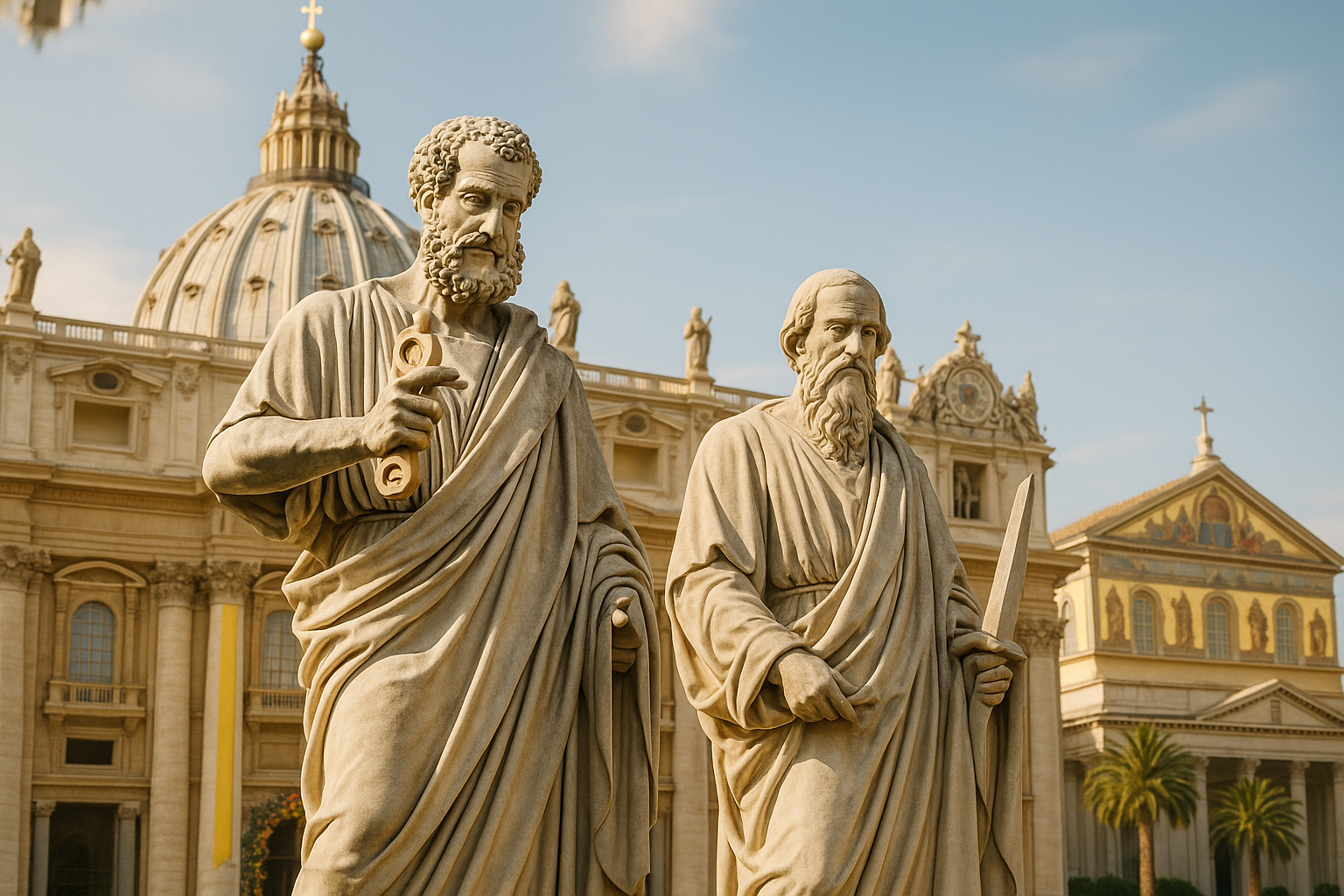
Every June 29, the Church gives us a feast that is both glorious and slightly surprising: the Solemnity of Saints Peter and Paul. Peter and Paul together? If you’ve ever imagined these two at the same parish picnic, you can already sense the tension. Peter is the fisherman-turned-prince-of-the-apostles—quick to speak and sometimes quicker to sink. Paul is the former persecutor turned missionary firebrand, the kind of man who could probably turn a casual conversation into a theology lecture before the coffee got cold.
And yet the Church celebrates them side by side for a reason.
The Solemnity of Saints Peter and Paul reminds us that the Church is built on apostolic witness, strengthened by martyrdom, and sent into the world with both authority and mission. Peter anchors the Church in unity. Paul pushes her outward in evangelization. Together, they show us what faithful discipleship looks like when grace gets to work.

Why June 29 Matters So Much
The Church celebrates this feast as a solemnity, which means it is one of the highest celebrations in the liturgical year. June 29 commemorates the martyrdom of Saints Peter and Paul in Rome, traditionally during the persecution under Emperor Nero.
That detail matters. Rome was not made holy because of political power, impressive buildings, or good marketing. It became holy because two apostles gave their lives there for Christ.
The Church’s liturgy and tradition honor Saints Peter and Paul as foundational witnesses to the Gospel. Peter represents the visible unity of the Church, while Paul represents her missionary reach. Their feast is not just a look back at ancient history. It is a reminder of where the Church came from and how she continues to live: by apostolic faith, apostolic teaching, and apostolic courage.

Peter: The Rock, the Keys, and the Shepherd
Peter’s role in the New Testament is impossible to miss. In Matthew 16:13–19 (NABRE), Jesus asks the disciples who they say He is. Peter answers with that great confession: “You are the Messiah, the Son of the living God” (Mt 16:16). Jesus responds with a new name and a new mission: “You are Peter, and upon this rock I will build my church” (Mt 16:18). Then He gives Peter the keys to the kingdom of heaven.
Now, before this starts sounding like a theology exam, here’s the simple Catholic point: Jesus was not being vague. He was establishing Peter in a unique role among the apostles. The Catechism of the Catholic Church explains that Peter receives a particular mission of service in the Church, and that this ministry continues in the successors of Peter, the bishops of Rome, especially the pope (see CCC 552–553, 881–882).
The keys are important. In Scripture, keys symbolize authority and stewardship, not domination. Peter is not the boss of the Church in the worldly sense. He is a shepherd charged with protecting unity and serving the flock of Christ.
That becomes even clearer in John 21:15–19. After the Resurrection, Jesus asks Peter three times, “Do you love me?” and after each answer, He says, “Feed my sheep.” It is a beautiful, healing moment. Peter had denied Jesus three times. Now he is restored three times. Christ does not simply forgive Peter; He recommissions him.
That tells us something deeply comforting: leadership in the Church is not built on personal perfection. It is built on love for Christ, expressed through service.
Peter gives us hope because he was so very human. He was brave, impulsive, loyal, afraid, and sometimes spectacularly confused. In other words, he was a lot like the rest of us. And Jesus built His Church on him anyway.

Paul: The Apostle to the Gentiles
If Peter represents unity and pastoral leadership, Paul represents mission and proclamation.
Paul’s conversion in Acts 9 is one of the dramatic turning points in salvation history. Saul, who had been persecuting Christians, is stopped on the road to Damascus by the risen Lord: “Saul, Saul, why are you persecuting me?” (Acts 9:4). That line is astonishing. Jesus does not say, “Why are you persecuting my followers?” He says, “Why are you persecuting me?” The Church is not a mere club of religious enthusiasts. She is the Body of Christ.
After his conversion, Paul becomes a man on fire with the Gospel. In Galatians 2:7–9, he explains that Peter was entrusted with the gospel to the circumcised, while he was entrusted with the gospel to the uncircumcised. Different mission fields, one Lord. Different apostolic callings, one faith.
That is a good reminder for us, too. Unity in the Church does not mean everyone has the same job, the same gifts, or the same temperament. Thank goodness. If every Catholic were a Paul, parish councils would never end. If every Catholic were a Peter, the Church might spend a lot more time wincing and recovering. Grace works through different personalities for the sake of one mission.
Near the end of his life, Paul writes with remarkable peace in 2 Timothy 4:6–8, 17–18: “I have competed well; I have finished the race; I have kept the faith.” Those words are not just the end of a biography. They are the summary of a life poured out for Christ.
Paul did not merely preach the Gospel. He became a living witness to it.
Martyrdom in Rome: Their Final Witness
Tradition holds that both apostles died in Rome under Nero. Peter was crucified upside down, according to ancient Christian tradition, because he felt unworthy to die in the same manner as Christ. Paul, as a Roman citizen, was beheaded.
Their deaths tell us something the modern world sometimes forgets: the Church is born not from comfort, popularity, or careful image management, but from sacrifice.
The word martyr means witness. Peter and Paul sealed their witness with blood. They did not die as polished success stories. They died as apostles faithful to the end.
That is why Rome holds such a special place in Catholic memory. The city became a center of Christianity not because of imperial power, but because two apostles gave everything there. The great basilicas over their tombs are not monuments to human glory. They are memorials to Christ’s victory in His saints.
What Peter and Paul Teach Us Today
Peter and Paul are different in personality, background, and vocation, but that is exactly why the Church celebrates them together. They complement each other beautifully.
Peter reminds us of:
– unity in the Church
– fidelity to Christ’s teaching
– humility in leadership
– trust in grace despite failure
Paul reminds us of:
– courage in evangelization
– conversion of heart
– zeal for the nations
– perseverance in suffering
Together, they show us that the Church needs both stability and mission. We need shepherds and missionaries, guardians of the faith and proclaimers of the faith, the kind of people who can both preserve the truth and carry it to the ends of the earth.
And that has very practical implications for ordinary Catholic life.
Maybe you are called to be more like Peter by strengthening unity in your family, parish, or workplace. Maybe you are called to be more like Paul by speaking about your faith with greater courage. Maybe you have to do both, depending on the day. Most of us do.
This feast is also a good reminder that sainthood does not require a perfect personality. It requires surrender to Christ. Peter had to learn humility. Paul had to learn that zeal without Christ is just spiritual overachievement. Both were transformed by grace.
A Feast for the Whole Church
The Solemnity of Saints Peter and Paul is more than a celebration of two holy men. It is a celebration of the Church herself: apostolic, catholic, missionary, and united in Christ.
It is a good day to pray for the pope, for bishops, for priests, for missionaries, and for all who labor to preserve the faith and spread it. It is also a good day to read the Gospel passages connected to these saints and ask a very honest question:
How is Christ calling me to be more like Peter in faith and more like Paul in zeal?
That question can be uncomfortable in the best possible way. The saints tend to do that. They don’t just inspire us; they kindly refuse to let us stay spiritually lazy.
Conclusion
Peter and Paul were different, but grace made them companions in holiness. One was the rock, the other the runner. One fed the sheep, the other carried the Gospel to the nations. Both loved Christ. Both gave their lives for Him. Both still speak to the Church today.
On June 29, we thank God for the apostles who helped build the Church, pray for the Church’s unity and mission, and ask for the courage to keep the faith as they did.
Their feast reminds us that the Gospel is worth everything.
And perhaps it also reminds us of something wonderfully Catholic and wonderfully human: God can do astonishing things with very ordinary people—fishermen, Pharisees, and the rest of us included.
FAQ: The Solemnity of Saints Peter and Paul
Why are Saints Peter and Paul celebrated on the same day?
Because both apostles were martyred in Rome and are foundational witnesses to the Church. Peter represents apostolic authority and unity; Paul represents mission and evangelization.
Is June 29 always a solemnity?
Yes, in the Roman Rite the Feast of Saints Peter and Paul is celebrated as a solemnity.
What does the Church teach about Peter?
The Church teaches that Peter received a unique role among the apostles and that his ministry continues in the bishops of Rome, especially the pope, as a service to unity and faithfulness to Christ (see CCC 552–553, 881–882).
Why is Paul called the Apostle to the Gentiles?
Because he was specially entrusted with preaching the Gospel to non-Jews, as he explains in Galatians 2:7–9.