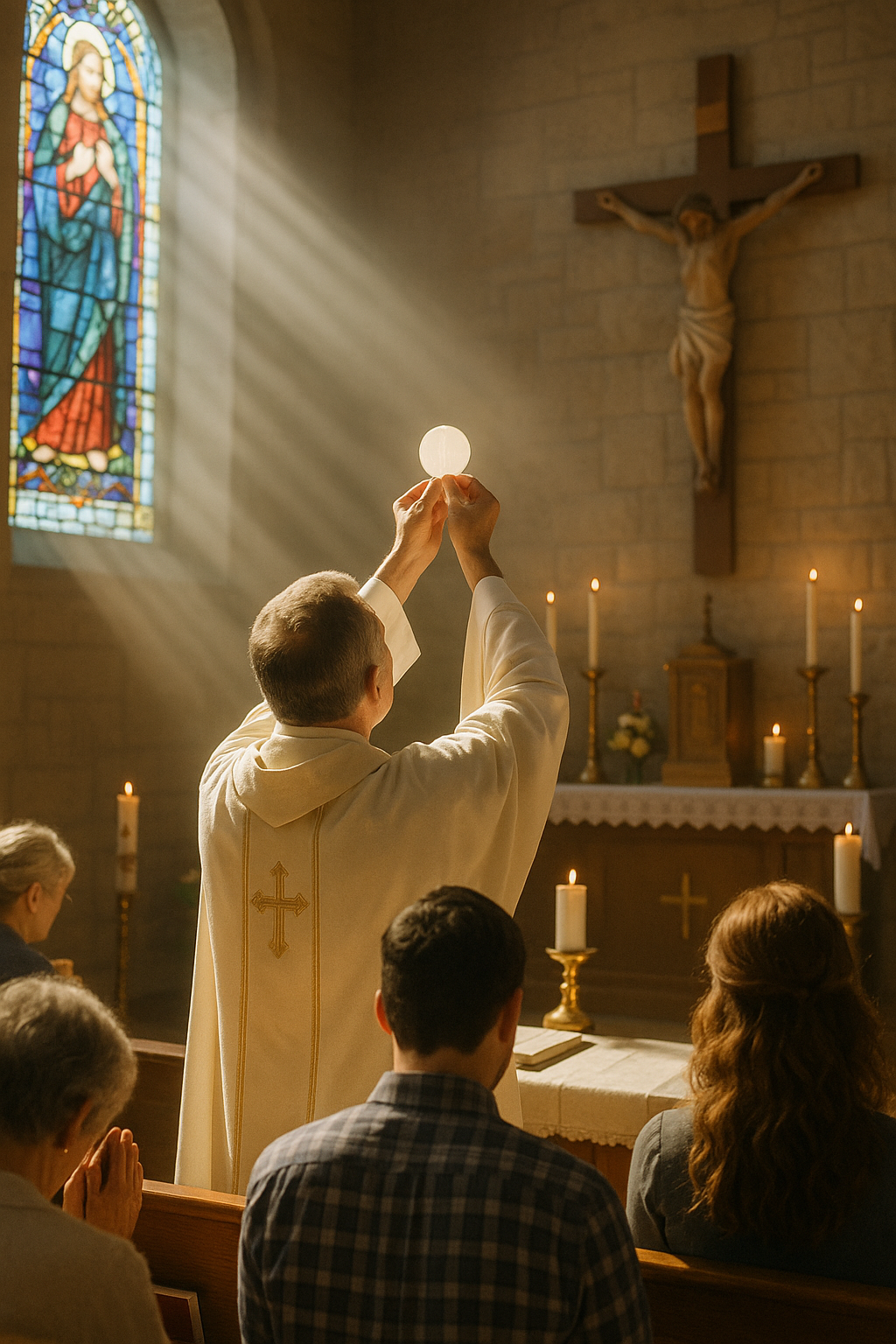
If you’ve ever heard Catholics talk about the sacraments and felt like you wandered into theology class a little early, you’re not alone. In simple terms, the Catholic sacraments are visible signs Jesus gave the Church to give grace, forgive sins, strengthen believers, and draw us into his life. Water, oil, bread, wine, words, and laying on of hands may seem ordinary, but in Catholic teaching, God loves using ordinary things to do extraordinary work.
The Catechism of the Catholic Church defines the sacraments as “efficacious signs of grace, instituted by Christ and entrusted to the Church, by which divine life is dispensed to us” (CCC 1131). In other words, they are not merely symbols. They truly communicate grace.
The Catholic Sacraments in Church Teaching
The Church teaches that there are seven sacraments, and each one marks a major stage of the Christian life. As the Catechism says, “The seven sacraments touch all the stages and all the important moments of Christian life” (CCC 1210).
Catholics group them into three categories:
Sacraments of Initiation
- Baptism
- Confirmation
- Eucharist
Sacraments of Healing
- Penance/Reconciliation
- Anointing of the Sick
Sacraments at the Service of Communion
- Holy Orders
- Matrimony
These are not random religious customs invented over parish coffee and donuts. They come from Christ, are rooted in Scripture, and have been handed on through the Church from the beginning.
Takeaway: The sacraments are not “extra credit” for super-Catholics. They are part of normal Christian life.

Why the Sacraments Matter
Here’s where things get interesting: Catholicism is not just a set of ideas. It is a living relationship with Jesus Christ. And because the Son of God became truly human—body and soul—it makes sense that he would continue to meet us through visible signs.
The sacraments are tied to Christ’s Paschal Mystery: his death and resurrection. They make that saving grace present to us here and now. So, when the Church talks about sacraments, she is talking about real encounters with the living Christ, not empty rituals.
This is one of the most misunderstood Catholic teachings: grace is not trapped in our feelings or ideas. God reaches us through matter because he made us body and soul.
Baptism: The Beginning of New Life
Baptism is the gateway to the Christian life. Jesus commanded his disciples: “Go, therefore, and make disciples of all nations, baptizing them…” (Matthew 28:19, NABRE). And in John 3:5, he says, “no one can enter the kingdom of God without being born of water and Spirit.”
The Catechism teaches that Baptism is “the basis of the whole Christian life, the gateway to life in the Spirit” (CCC 1213). Through Baptism, original sin is washed away, we become children of God, and we are made members of the Church.
This is why the Church treats Baptism as so foundational. It is not just a sweet family moment with adorable pictures and one very squirmy baby. It is spiritual rebirth.
Confirmation: Strengthened by the Holy Spirit
Confirmation deepens the grace of Baptism and strengthens us for mission. In Acts 8:14–17, the apostles lay hands on the baptized so they may receive the Holy Spirit. The Church sees Confirmation as a real outpouring of the Spirit, not just a Catholic graduation ceremony with nicer clothes.
The Catechism explains that Confirmation gives a special outpouring of the Holy Spirit, rooting us more deeply in divine sonship and binding us more firmly to the Church (CCC 1285).
At its heart, Confirmation is about being sealed and strengthened to live as a witness to Christ. The Holy Spirit does not merely inspire us for an afternoon. He equips us to live the faith with courage.

Eucharist: The Source and Summit
Now we come to the heart of Catholic life: the Eucharist. If the sacraments are a family, the Eucharist is the family meal—except this meal feeds the soul and unites us to Christ himself.
At the Last Supper, Jesus said, “This is my body, which will be given for you” (Luke 22:19, NABRE). In John 6, he speaks even more directly about the Bread of Life: “whoever eats my flesh and drinks my blood has eternal life” (John 6:54, NABRE).
The Church teaches that the Eucharist is the “source and summit of the Christian life” (CCC 1324). Catholics believe Christ is truly present—Body, Blood, Soul, and Divinity—in the Eucharist. That is why Mass is not merely a gathering for encouragement, though encouragement is nice. It is a holy encounter with the living Christ.
The Eucharist forms us, feeds us, and unites us to the sacrifice of Christ. It is the sacrament of communion in the deepest sense.
Penance/Reconciliation: God’s Mercy in Action
We all sin. Not exactly breaking news. The real question is what God does about it.
In John 20:22–23, Jesus breathes on the apostles and says, “Whose sins you forgive are forgiven them.” That is the biblical foundation for the sacrament of Reconciliation. Christ gives the Church real authority to forgive sins in his name.
Through confession, absolution, and penance, Catholics are restored to grace after sin. The Catechism says this sacrament “gives the sinner the grace of conversion” and reconciles us with God and the Church (CCC 1422–1424).
This sacrament is one of the clearest signs that God is not stingy with mercy. He does not stand back with folded arms waiting to say, “Well, that was disappointing.” He comes toward us, ready to heal and restore.
Takeaway: Reconciliation is not about humiliation. It is about freedom, mercy, and being brought home.
Anointing of the Sick: Strength in Suffering
When someone is seriously ill, elderly, or facing major surgery, the Church offers the Anointing of the Sick. James 5:14–15 says, “Is anyone among you sick? He should summon the presbyters of the church, and they should pray over him and anoint him with oil in the name of the Lord.”
This sacrament brings peace, strength, and healing according to God’s will. Sometimes physical healing happens. Sometimes the greater gift is the grace to endure suffering with faith and courage.
In a culture that often rushes past suffering, this sacrament says pain can be united to Christ. Suffering does not get the final word.
Holy Orders: Serving the Church
Holy Orders is the sacrament through which bishops, priests, and deacons are ordained for ministry. Christ chose the Twelve and sent them to continue his mission. The Church sees this sacrament as the continuation of apostolic ministry through the laying on of hands (see Acts 6:6; 1 Timothy 4:14).
The Catechism teaches that Holy Orders configures ordained ministers to Christ, the Head of the Church, for service to the People of God (CCC 1536).
This sacrament is not about status or spiritual career advancement. It is about service. In the Catholic imagination, authority in the Church is meant to be ordered toward sacrifice, shepherding, and holiness.
Matrimony: A Sacrament of Love
Marriage is more than a legal contract in Catholic teaching. Between two baptized persons, Matrimony is a sacrament—a covenant that reflects Christ’s faithful love for the Church. Genesis 2:24 says that husband and wife become “one flesh,” and Ephesians 5:25–32 compares marriage to the love between Christ and the Church.
The Catechism teaches that Matrimony is ordered toward the good of the spouses and the procreation and education of children (CCC 1601). In other words, it is about mutual self-gift and the building up of a family, both natural and spiritual.
Marriage is not just about romance, although romance is lovely. It is a vocation to holiness. It asks for patience, sacrifice, forgiveness, and grace—the whole package.

Why the Sacraments Are a Gift
The sacraments meet us where we are. They mark our birth into the faith, sustain us through life, heal us when we fall, and send us out in mission. They are not magic tricks, and they are not human inventions. They are Christ’s gifts to his Church.
This is what makes them so beautiful: the Christian life is not a solo project. Jesus walks with us through concrete moments, real needs, and ordinary human life. The sacraments are how God keeps saying, in effect, “I am with you.”
If you want to understand Catholicism, you have to understand the sacraments. They are the family life of the Church: how God gives grace, how he draws us close, and how he keeps us moving toward heaven.
Final Thoughts
So, what are Catholic sacraments? They are visible signs instituted by Christ that truly communicate God’s grace and help us grow in holiness. Through the seven sacraments, Jesus accompanies us from baptismal new birth to our final moments of healing and hope.
If you want to go deeper, read the relevant sections of the Catechism of the Catholic Church (CCC 1113–1134 and 1210–1666), along with the Gospel passages connected to each sacrament. And of course, pray with this truth. The sacraments are not just something to study—they are gifts to receive.
Frequently Asked Questions
Are the sacraments in the Bible?
Yes. The Church teaches that the sacraments are rooted in Scripture and instituted by Christ. You can see their foundations in passages like Matthew 28:19, John 3:5, John 20:22–23, Luke 22:19, James 5:14–15, and others.
Why does the Catholic Church have seven sacraments?
Because these seven were recognized by the Church as the sacramental actions that touch every major stage of Christian life: initiation, healing, and service.
Do sacraments really give grace?
Yes. That is exactly what the Church teaches. They are not just reminders of grace; they are effective signs that confer grace because Christ is the one acting through them.
Is the Eucharist really the body and blood of Christ?
Yes. Catholics believe in the Real Presence of Christ in the Eucharist—Body, Blood, Soul, and Divinity. This is one of the central teachings of the Church.