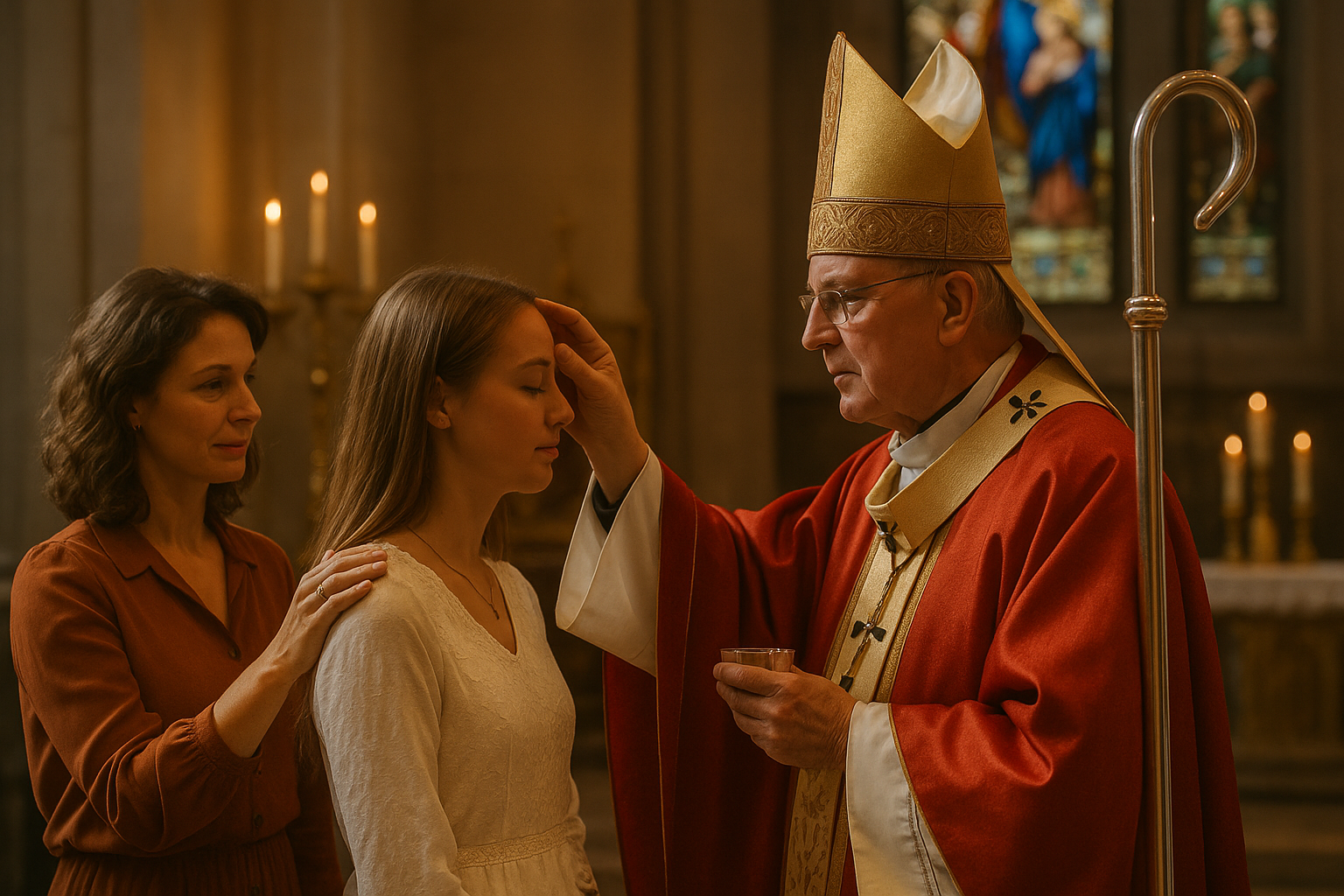
If you’ve ever heard Confirmation described as “Catholic graduation,” you’re not alone. It’s one of those phrases that sounds tidy enough—until you realize it misses the whole point. Catholic Confirmation is not the end of catechism, not a spiritual diploma, and definitely not a fancy church event followed by cake and a vague promise to “stay involved.”
Confirmation is a sacrament.
That means it is an act of God, not just a milestone in human development. In Confirmation, the Holy Spirit strengthens the grace received at Baptism and seals the Christian for mission in the life of the Church. The Catechism teaches that Confirmation “perfects Baptismal grace” and gives “a special outpouring of the Holy Spirit” so the confirmed person may be rooted more deeply in Christ and bear witness to Him (CCC 1316, 1302).
In plain English: God is saying, You belong to me, and I’m strengthening you for the road ahead.

Confirmation in Scripture
Catholics didn’t invent Confirmation because it sounded neat on a parish brochure. Its roots are in Scripture, especially in the Acts of the Apostles.
Pentecost and the Gift of the Holy Spirit
At Pentecost, the Holy Spirit descends on the apostles, and they begin proclaiming the Gospel with courage and clarity (Acts 2:1–11). It’s not hard to see the connection: the Spirit gives power for witness. That same Spirit is given to the Church in Confirmation.
Now, before this starts sounding like a theology final exam, here’s the simple idea: Confirmation continues the Pentecost pattern. The Holy Spirit doesn’t just comfort believers; He strengthens them for mission.
The Laying on of Hands
Two passages are especially important:
– Acts 8:14–17 — Peter and John lay hands on baptized Samaritans, and they receive the Holy Spirit.
– Acts 19:5–6 — Paul lays hands on baptized believers in Ephesus, and the Holy Spirit comes upon them.
These passages show that the early Church recognized a distinct action connected to the gift of the Holy Spirit after Baptism. The Church has always understood Confirmation as the apostolic continuation of that practice.
In other words, this isn’t a later Church add-on. It’s rooted in how the Apostles themselves ministered.
What Confirmation Does
According to the Catechism, Confirmation has several beautiful effects:
– It deepens baptismal grace
– It roots us more firmly in divine filiation, meaning we grow more deeply as children of God
– It unites us more closely to Christ
– It increases the gifts of the Holy Spirit
– It strengthens our bond with the Church
– It gives us special strength to spread and defend the faith by word and action (CCC 1303)
That last point matters a lot. Confirmation is not mainly about a warm feeling, an inspiring moment, or a photo that makes everyone look slightly more nervous than usual. It is about being equipped.
Baptism gives new life. Confirmation strengthens that life. The Eucharist nourishes it. Together, they form the sacramental foundation of Christian initiation.
The Gifts of the Holy Spirit
One of the most well-known effects of Confirmation is the strengthening of the seven gifts of the Holy Spirit:
1. Wisdom
2. Understanding
3. Counsel
4. Fortitude
5. Knowledge
6. Piety
7. Fear of the Lord
These gifts are not reserved for stained-glass saints or people who naturally seem to have their life together. They help ordinary Catholics make good decisions, remain faithful under pressure, and grow in holiness at work, at school, and at home.
Yes, even when the family group chat turns into a minor diplomatic crisis, the Holy Spirit is still at work.
These gifts help us respond to God more readily, especially when life gets complicated, noisy, or just plain exhausting.

The Rite of Confirmation
In the Latin Church, the essential rite of Confirmation includes:
– Anointing with Sacred Chrism on the forehead
– The words: “Be sealed with the Gift of the Holy Spirit”
– The laying on of hands by the bishop or an authorized priest
Sacred Chrism is a specially consecrated oil. And oil, as it turns out, has serious biblical credentials. In the Old Testament, oil was used to anoint kings, priests, and prophets. It symbolized being set apart for God’s service.
In Confirmation, the Christian is marked and strengthened for a share in Christ’s own mission as Priest, Prophet, and King.
The Catechism teaches that Confirmation leaves an indelible spiritual mark or “character,” which means it can be received only once (CCC 1304). Like Baptism, it leaves a permanent seal on the soul.
That’s a big deal. This sacrament is not something we “redo” when life gets messy or when we want a spiritual refresh button. It is a lasting gift.
Who Can Receive Confirmation?
Confirmation is for those who are:
– Already baptized
– Not yet confirmed
– Properly prepared
– In a state of grace, if possible
The Catechism encourages the faithful to receive the sacrament with proper instruction and spiritual readiness (CCC 1309–1310). If someone is conscious of grave sin, Confession should come first.
Canon Law says Confirmation should be conferred at “about the age of discretion,” unless a bishops’ conference establishes another age (CIC 891). In practice, the age varies by diocese. In many parts of the United States, it is received in middle school or high school, depending on local norms.
That variation can confuse people a little, especially if they move dioceses and suddenly discover that “the Confirmed Age” is apparently a diocesan mystery. But the Church’s point is consistent: the sacrament should be received with real readiness, not just because a calendar says so.
The Role of Confirmation Sponsors
Confirmation sponsors are not there just to stand beside the candidate, look respectable, and pretend they know exactly when to respond in the rite. Their job is serious.
The Catechism and Canon Law expect sponsors to help the confirmed person live the faith faithfully. A sponsor should be a confirmed, practicing Catholic who is able to support the candidate’s spiritual life (CCC 1311–1312; canon 893).
A good sponsor is someone who can say, in effect:
– “I’ll pray for you.”
– “I’ll check in on you.”
– “I’ll help you stay close to Christ.”
That is a lot more helpful than, “Congrats on the chrism.”
Sponsors matter because the Christian life is not meant to be lived solo. The Church is a family, and families help one another stay faithful.

Why Confirmation Matters Today
Confirmation matters because Catholics need the Holy Spirit now more than ever.
We live in a world that often tells believers to keep faith private, hidden, or politely tucked away like a guest room nobody opens. But Catholic faith was never meant to be locked in the spiritual pantry.
The confirmed Christian is strengthened to live publicly as a disciple of Jesus Christ.
The USCCB teaches that Confirmation deepens our baptismal life and calls us to be missionary witnesses in our families, neighborhoods, society, and the world. That’s not just a nice slogan. It’s a real call.
Confirmation matters because it helps Catholics:
– Stand firm in the faith
– Resist temptation
– Speak about Christ with courage
– Serve others with charity
– Remain united to the Church
– Take responsibility for their spiritual life
This is a sacrament for mature discipleship, not merely a church rite of passage.
Or to put it another way: Confirmation is not “now you’re done.” It is “now you’re sent.”
How to Prepare Well
If you or someone you know is preparing for Confirmation, here are some good steps:
– Pray regularly, especially to the Holy Spirit
– Read the Gospels and Acts of the Apostles
– Go to Confession
– Attend Mass faithfully
– Learn the Creed and the basic teachings of the Church
– Choose a good sponsor who lives the faith well
– Ask the saints, especially Pentecost saints like St. Teresa of Avila or St. Catherine of Siena, to intercede
Preparation should not feel like a paperwork requirement with a saint-shaped form attached. It is a time to open the heart to God.
It is also a good moment to ask a very practical question: Do I actually want the Holy Spirit to change me? Because that’s what this sacrament is about. Grace is free, but it is never cheap.
Confirmation and Everyday Catholic Life
Here’s where things get really interesting: Confirmation is not just about one day in church. It has real consequences for Monday morning.
A confirmed Catholic is called to live with courage, prudence, and charity in ordinary life. That means:
– telling the truth when it would be easier to dodge it
– praying when prayer feels dry
– forgiving when forgiveness feels inconvenient
– defending the faith with kindness instead of panic
– serving others without needing applause
This teaching actually has a lot to do with everyday life. The Holy Spirit doesn’t just show up for the big moments. He strengthens us for the ordinary ones too—the small decisions, the hidden sacrifices, the patient endurance that nobody claps for but heaven notices.
That is the quiet power of Confirmation.
Final Thoughts
Catholic Confirmation is a powerful sacrament of grace, mission, and spiritual maturity. It completes baptismal initiation, seals the soul with the Holy Spirit, and strengthens Catholics to live boldly as witnesses of Christ.
So if you are preparing for Confirmation—or if you were confirmed years ago—take a moment to remember what the sacrament means. You have been marked by the Holy Spirit for a purpose.
Ask yourself: Am I living as someone strengthened by the Spirit? Am I willing to be a witness for Christ?
The Holy Spirit is not a distant idea. He is God living and active in the Church and in your life. Confirmation is His gift of strength for the road ahead.
Pray, study, receive the sacraments, and let the Holy Spirit renew your faith.
Frequently Asked Questions About Catholic Confirmation
Is Confirmation required for Catholics?
While Baptism is necessary for Christian initiation, Confirmation is a sacrament of initiation that completes and perfects baptismal grace. Catholics are strongly encouraged to receive it when properly prepared (CCC 1306–1311).
Is Confirmation the sacrament of becoming an adult Catholic?
Not exactly. It is often received during adolescence, but its meaning is spiritual, not merely developmental. Confirmation strengthens baptismal grace and equips the person for Christian witness.
Do you have to be in a state of grace to be confirmed?
You should be properly disposed, and if you are conscious of grave sin, you should go to Confession first. The sacrament is meant to be received reverently and worthily.
Can Confirmation be received more than once?
No. Like Baptism, Confirmation leaves an indelible spiritual mark or character and can be received only once (CCC 1304).