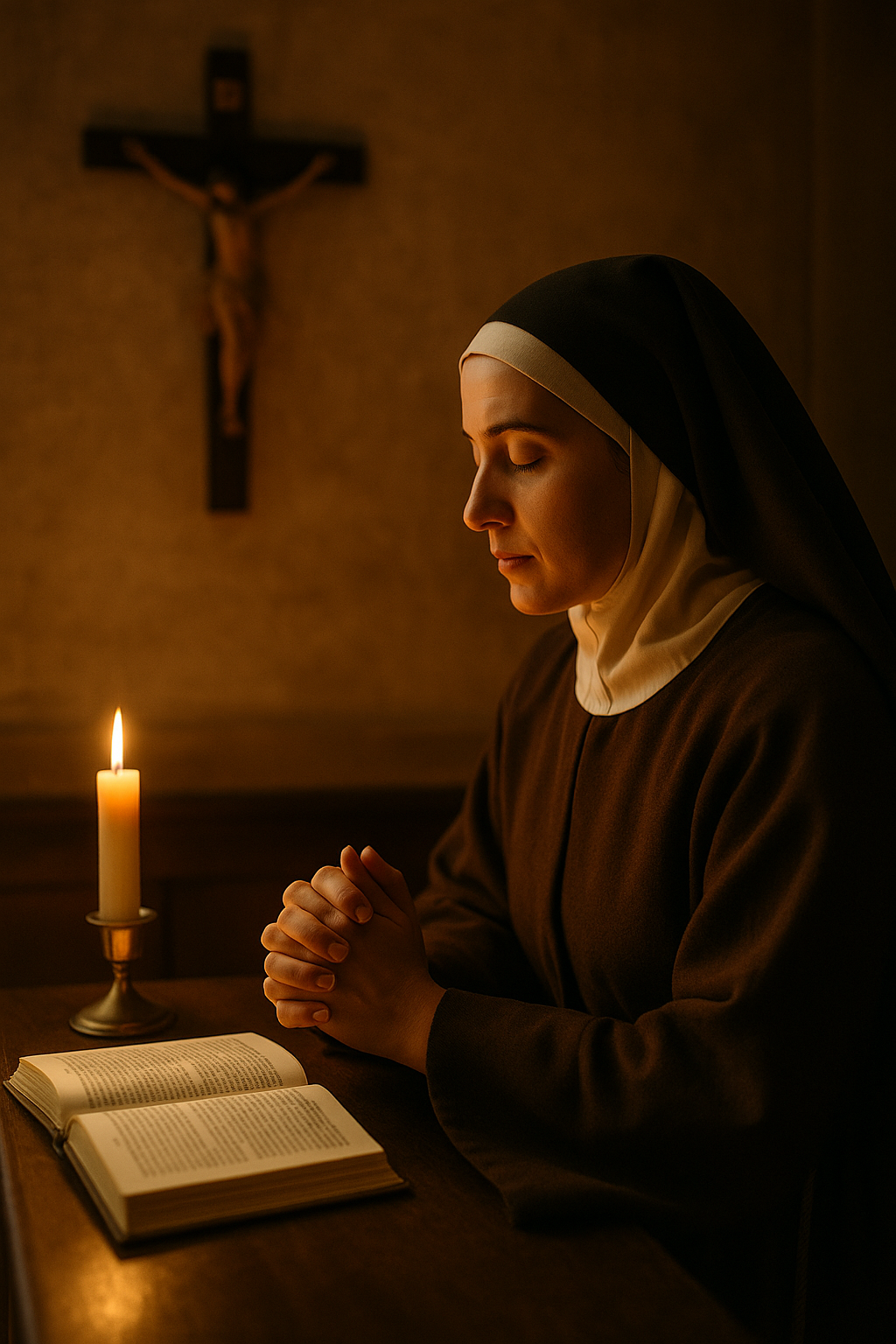
Let’s be honest: many of us approach prayer like we approach a crowded parish parking lot on Sunday morning—well-intentioned, slightly stressed, and hoping we end up in the right place. If you’ve ever sat down to pray only to realize your mind wandered to dinner, deadlines, or whether you left the laundry in the machine, St. Teresa of Ávila understands you perfectly.
St. Teresa of Ávila is one of the Church’s greatest teachers on how to pray. She reminds us that prayer is not about sounding impressive. It is about staying close to Christ. In a world full of noise, distraction, and spiritual multitasking, Teresa gives us a refreshingly simple message: pray as a friend speaks to a friend.
Born in 1515 in Ávila, Spain, Teresa Sánchez de Cepeda y Ahumada entered the Carmelite convent in 1535. Over time, she became convinced that the Church needed renewal through prayer, humility, and simplicity. Her influence eventually reached the whole Church. In 1970, Pope Paul VI declared her the first woman Doctor of the Church, recognizing the lasting importance of her teaching.

St. Teresa of Ávila and the Meaning of Prayer
What makes Teresa so compelling is that her mysticism was never detached from real life. She was not floating around in some spiritual cloud with a perpetual halo and zero responsibilities. She managed convents, dealt with opposition, traveled constantly, and wrote with remarkable clarity.
Her life proves that deep prayer and active responsibility do not cancel each other out. In fact, they strengthen one another.
Pope Benedict XVI noted that Teresa’s spirituality is profoundly Christ-centered. That matters because Teresa never treated prayer as vague relaxation or empty mindfulness. For her, prayer meant friendship with a Person. As she famously described it, prayer is “an intimate sharing between friends” with Christ.
That simple definition has helped generations of Catholics rediscover prayer as relationship rather than obligation.
A beautiful biblical connection here is John 15:4-5, where Jesus says, “Remain in me, as I remain in you.” Teresa would absolutely love that verse. Her whole spiritual vision is built around abiding in Christ, especially through the interior life.
The Interior Castle: The Soul’s Journey to God
Teresa’s most famous work, The Interior Castle, remains one of the great treasures of Catholic spirituality. In it, she compares the soul to a castle with many mansions, or rooms, leading toward the center where God dwells.
The image is unforgettable because it captures something true: the spiritual life is a journey inward toward deeper communion with God.
The Catechism of the Catholic Church teaches that contemplative prayer is the prayer of the heart fixed on Jesus, and that it requires humility and perseverance (CCC 2709–2719). Teresa’s teaching fits this beautifully. She understood that growth in prayer is gradual. The soul does not leap instantly to holiness. It passes through distractions, dryness, self-knowledge, purification, and conversion.
This is one of the most misunderstood Catholic teachings about prayer: dryness does not automatically mean failure. Sometimes God is purifying our hearts and teaching us to love Him for who He is, not for the feelings we want to get out of prayer.
In Scripture, this also resonates with Romans 12:2: “Be transformed by the renewal of your mind.” Teresa’s castle is not a fantasy world; it is the Christian soul being transformed by grace.

Her Reform of the Carmelite Order
Teresa was also a reformer in the best Catholic sense: she wanted to renew, not rebel. She believed the Carmelite life should be marked by poverty, enclosure, simplicity, fraternity, and prayer. In 1562, she founded the first reformed Carmelite convent in Ávila. This eventually led to the Discalced Carmelites, meaning “unshod,” or barefoot Carmelites, a sign of simplicity and detachment.
Her reform was rooted in love for the Church, not frustration with it. She wanted religious life to shine more clearly as a witness to the Gospel. That is a good reminder that reform in the Church is healthiest when it begins with holiness, humility, and fidelity.
Her collaboration with St. John of the Cross later helped extend the reform among Carmelite friars. Together, they became two of the greatest voices in the Catholic spiritual tradition.
What St. Teresa of Ávila Teaches Us About Prayer
Teresa has a lot to say to ordinary Catholics today. She reminds us that prayer is not a luxury for the spiritually elite. It is essential for every Christian. The Catechism teaches that prayer is a living relationship with the living God (CCC 2558–2565). Teresa makes that teaching feel personal and practical.
Here are a few of her key lessons:
– Start with honesty. Self-knowledge matters. We cannot grow if we pretend we are already saints.
– Be faithful, not flashy. Prayer is not about spiritual drama. It is about perseverance.
– Stay close to Jesus. Teresa kept returning to Christ’s humanity, mercy, and love.
– Don’t quit when prayer feels dry. Dryness is not failure. Sometimes it is part of the journey.
– Let prayer change your life. Real contemplation bears fruit in charity, patience, and humility.
This is exactly why Teresa pairs so well with Luke 18:1: “They ought to pray always and not lose heart.” She is a saint for people who struggle, not just for people who glow in chapel light.

Why St. Teresa of Ávila Still Matters
St. Teresa of Ávila matters because she shows that holiness is not about escaping the world; it is about letting God transform us within it. She knew suffering, opposition, confusion, and limitations. Yet she also knew joy, courage, and deep union with Christ.
Her life tells us that prayer is possible in the middle of ordinary life, and that the soul can become a dwelling place for God.
If you are looking for a saint who understands both the beauty and the messiness of the spiritual life, Teresa is a wonderful guide. She invites us to enter the interior castle, not by our own strength, but by grace.
As she once said, “Let nothing disturb you, let nothing frighten you. All things are passing: God never changes.” That is classic Teresa: steady, wise, and a little bold. Exactly what we need.
Leave a Reply