If you’ve ever planted a garden, you probably know that you can’t just throw seeds on the ground, walk away, and expect a beautiful harvest. Well, you can try, but the results might be a little disappointing.
You have to prepare the soil, remove weeds, clear away roots, and make sure the ground is ready for whatever you’re planting.
Which brings us to one of Jesus’ most familiar parables: the Parable of the Sower and the Seed (Mark 4:2–20).
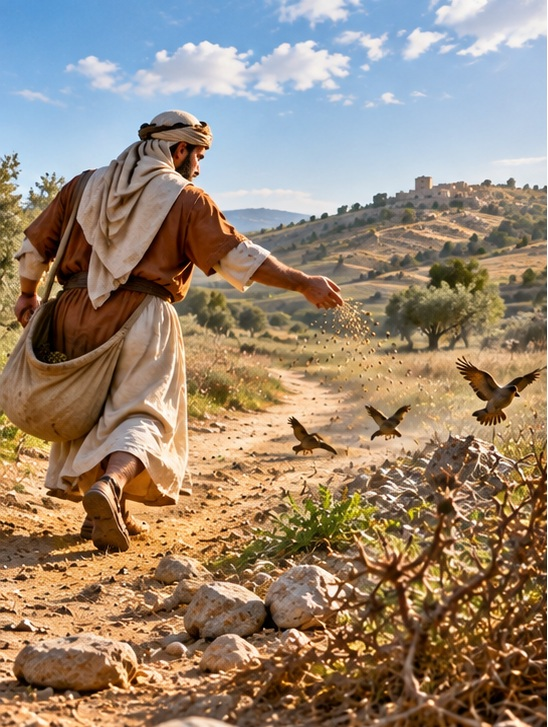
We’ve probably heard this parable many times at Mass. A farmer goes out to sow his seed. Some falls on a path, some on rocky ground, some among thorns, and some on rich soil. Only the seed that falls on rich soil produces an abundant harvest.
Jesus explains that the seed represents the Word of God and the different types of soil represent the ways people receive that Word.
Seems straightforward enough.
But there are a few things about this parable that deserve a closer look. And one of them might change the way we think about God’s relationship with us.

Is the Sower a Careless Farmer?
Let’s be honest. At first glance, the sower doesn’t seem particularly good at his job.
Why would a farmer scatter valuable seed on a hard path where birds will eat it? Why throw seed onto rocky ground where roots can’t develop? And why bother sowing among thorns that will eventually choke the plants?
Wouldn’t it make more sense to plant everything in the richest soil and get the best possible harvest?
After all, that’s what any sensible farmer would do.
But Jesus isn’t giving us a lesson in agricultural efficiency. He’s teaching us something about God.
And perhaps the apparent carelessness of the sower is actually one of the most beautiful parts of the parable.
Preparing the Soil: A Lesson from My Own Garden
I was reminded of this parable when I was installing new plants around my house.
Before I could plant anything, I had to prepare the ground. And that turned out to be more work than I expected.
There were weeds to remove, old roots to dig out, and soil that needed attention before the new plants could take hold.
Simply putting new plants into unprepared ground wasn’t going to give them much of a chance.
And as I worked, I began to see a connection between that garden and my own spiritual life.
Because in many ways, we are the soil.
And just like a garden, our hearts sometimes need a little attention.

What Is Growing in Our Hearts?
Jesus describes four types of soil in the parable. Each represents a different response to the Word of God.
The hard path represents those who hear the Word but never allow it to take root.
The rocky ground represents those who receive the Word with joy but abandon it when difficulties arise.
The thorny ground represents those who hear the Word but allow worldly anxieties, riches, and other desires to choke it.
And the rich soil represents those who hear the Word, accept it, and bear fruit.
It’s easy to read this parable and start thinking about which category other people belong to.
But perhaps the more important question is: What kind of soil am I?
Most of us probably have a little of all four.
There are areas of our lives where our faith is strong and fruitful. But there may also be places where the ground is hard, the roots are shallow, or the weeds have gotten out of control.
Those weeds might be painful memories, old hurts, or feelings of shame that we’ve carried for years.
They might be anger, jealousy, resentment, or an unwillingness to forgive.
Sometimes they’re the ordinary distractions of life: worrying about money, chasing success, or becoming so busy that we leave little room for God.
And just like the weeds in my garden, these things don’t always disappear on their own.
They need attention.
Fortunately, we don’t have to do that work alone. God’s grace helps us recognize what needs to change and gives us the strength to begin.
Why Does God Keep Sowing?
Now let’s return to that seemingly careless farmer.
If the sower represents God, why does He scatter the seed everywhere instead of concentrating only on the good soil?
Because God’s love isn’t limited to those who are already prepared to receive it.
Think about that for a moment.
If God only offered His Word to people whose hearts were perfectly prepared, how many of us would qualify?
Probably not very many.
But God doesn’t wait for us to become perfect before inviting us into a relationship with Him.
He continues to reach out.
He continues to call.
He continues to offer His grace, even when our hearts are hardened by disappointment, wounded by past experiences, or crowded with the concerns of everyday life.
The Catechism reminds us that God’s grace comes first and calls forth our free response (CCC 2001–2002). God takes the initiative, but He also invites us to cooperate with Him.
That is an important distinction.
The sower is not lazy or careless. He is generous beyond anything we would expect from an ordinary farmer.
And His generosity gives us hope.
The hard ground can be broken up. The rocks can be removed. The thorns can be cleared away.
With God’s grace, the condition of our hearts can change.

Sometimes We Admire Someone Else’s Garden
Have you ever met someone whose faith seemed almost effortless?
Someone who trusts God through difficult circumstances, finds peace in prayer, or seems to have an unshakable confidence in God’s love?
It’s easy to look at people like that and wish we had the same faith.
We might wonder why their spiritual garden seems to be flourishing while ours still has a few stubborn weeds.
But perhaps that admiration can serve a purpose.
Instead of becoming discouraged, we can allow their example to inspire us to examine our own lives.
What is preventing God’s Word from taking deeper root in my heart?
What worries or resentments am I holding onto?
Am I making room for prayer, Scripture, the sacraments, and the quiet work of the Holy Spirit?
These aren’t always comfortable questions.
But gardens don’t become fruitful simply because we admire the flowers growing next door.
At some point, we have to tend our own soil.
We Are Also Called to Be Sowers
There is one more lesson in this parable that I think is especially important.
We aren’t only the soil.
We are also called to become sowers.
Through our words and actions, we plant seeds in the lives of others, sometimes without even realizing it.
A kind word to someone who is struggling.
A willingness to forgive.
An act of generosity.
A conversation about faith.
The quiet example of someone who continues to trust God even during difficult times.
These may seem like small things, but we never know when one of those seeds might take root.
Saint Paul reminds us of this when he writes:
“I planted, Apollos watered, but God caused the growth.” (1 Corinthians 3:6, NABRE)
That’s worth remembering.
We are called to sow the seeds of faith, but we aren’t responsible for forcing them to grow.
That work belongs to God.
Sometimes we may share our faith with someone who seems completely uninterested. We might offer encouragement that appears to make no difference. We may pray for someone for years without seeing any visible change.
But that doesn’t mean the seed was wasted.
God works in ways and on a timetable that we don’t always understand.
Our responsibility is to remain faithful, loving, and patient, trusting Him with the harvest.
A Final Thought: Keep Tending the Garden
The Parable of the Sower and the Seed is more than a story about how people respond to God’s Word. It is also a reminder of God’s extraordinary generosity and our continuing need for spiritual growth.
God keeps sowing, even when the ground isn’t ready.
He doesn’t abandon us because our hearts are rocky or overgrown with thorns.
Instead, He invites us to cooperate with His grace, remove the obstacles that keep us from Him, and become more receptive to His Word.
And as we grow in faith, He calls us to help sow those same seeds in the lives of others.
So perhaps the next time we hear this parable at Mass, we should ask ourselves two simple questions:
What needs to be removed from the garden of my heart?
And what seeds of faith am I planting in the lives of others?
We may not always see the results of our efforts. Some seeds take longer to grow than others.
But with faith, love, patience, and the help of the Holy Spirit, even the most neglected garden can become fruitful.
And thankfully, God never gives up on the gardener—or the garden.
Leave a Reply