Feast Day: Oct 4
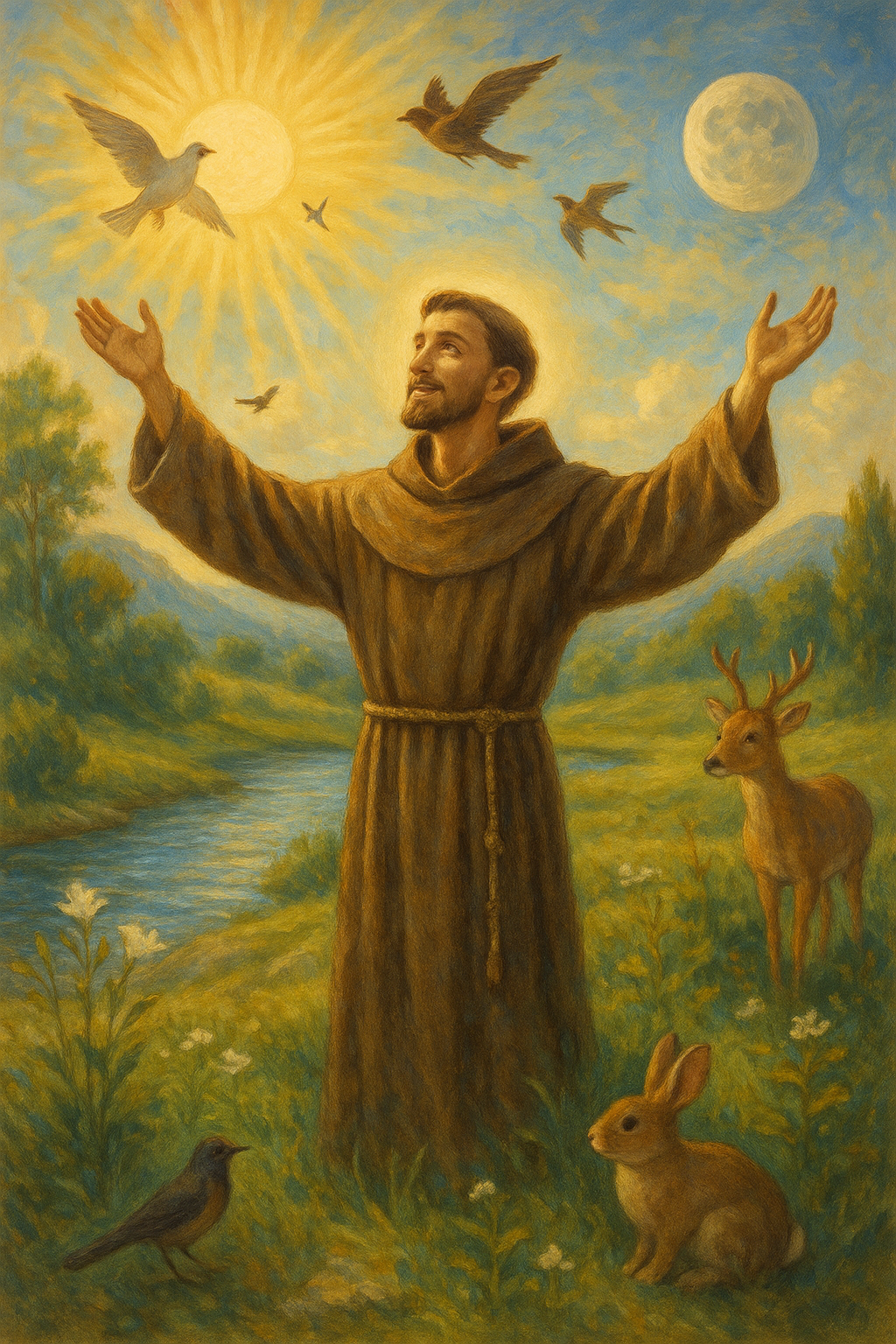
Let’s be honest: a lot of people know St. Francis of Assisi as “the saint with the birds” or the guy who looks permanently ready for a garden statue. Charming? Absolutely. Complete? Not even close.
St. Francis of Assisi was not a sentimental mascot for nature. He was a man who heard the Gospel, took it seriously, and lived it with such radical simplicity that he still makes the rest of us look a little overpacked. In a world obsessed with status, comfort, and control, St. Francis reminds us that holiness is possible—and that joy can coexist with sacrifice.

Who Was St. Francis of Assisi?
Francis was born in Assisi, Italy, around 1181 or 1182. As a young man, he enjoyed wealth, social status, and dreams of military glory. In other words, he had the kind of life that looks impressive on paper.
But life has a way of interrupting our plans. After illness, imprisonment, and a deep interior struggle, Francis began to see everything differently. The turning point came when he prayed before the crucifix at San Damiano and sensed Christ telling him to “repair my house.”
At first, Francis took that quite literally, restoring damaged churches with his own hands. But the deeper call was spiritual: Christ was inviting him to help renew the Church through conversion, poverty, and holiness.
That moment became the beginning of a vocation that would change the Church—and still challenges Catholics today.
St. Francis of Assisi and the Gospel of Poverty
Now, before this starts sounding like a pointed theology lesson, let’s clarify something important: Francis did not embrace poverty because he thought material things were evil. He loved creation, food, friendship, and the goodness of life. What he rejected was attachment—especially the kind that makes the heart too crowded for God.
Francis wanted freedom.
The Gospel passage that especially shaped him was Matthew 10:5-14, where Jesus sends the apostles out with little more than trust in God’s providence. Pope Benedict XVI noted that this passage helped Francis understand his calling to live in poverty and proclaim the Gospel.
That’s why Francis renounced his inheritance and chose to live simply among the poor. His life echoed Jesus’ words:
“If you wish to be perfect, go, sell what you have and give to the poor” (Matthew 19:21, NABRE).
Franciscan poverty is not about being miserable on purpose. It is about being free—free from greed, free from self-reliance, and free to love generously.
The Catechism reminds us that the Church has a special care for the poor and that the goods of creation are meant for everyone, not just the people who happened to get there first (see CCC 2401–2449).
Takeaway: St. Francis asks a simple but uncomfortable question: What owns me? If our possessions, ambitions, or anxieties are in charge, we are not nearly as free as we think.

The Joy of Brotherhood
Francis also gathered companions who became the Friars Minor, or “Lesser Brothers.” The name is wonderfully disarming. No grand titles. No spiritual peacocking. Just brothers who were to be small, humble, and servant-like.
Francis never wanted his brothers to dominate others. He wanted them to imitate Christ, who “did not come to be served but to serve” (cf. Mark 10:45).
This brotherhood wasn’t just internal to his religious order. Francis called others “brother” and “sister” because he saw all people as children of the same Father. That’s a small phrase with a big effect. It’s hard to treat someone as disposable when you’ve trained yourself to call them family.
And honestly, in a world that feels more divided by the day, that Franciscan instinct has a lot to teach us.
Pope Francis has often highlighted St. Francis as a model of fraternity and dialogue, especially in Fratelli Tutti, where the saint’s meeting with the Sultan is held up as a witness to peace and human dignity.
Peace, Not Power
St. Francis lived in a time of conflict, but he was known as a man of peace. During the Fifth Crusade, he traveled to Egypt and met Sultan al-Malik al-Kamil. Instead of approaching him with hostility, Francis came as a witness to Christ, seeking conversation and peace.
That took real courage. Christian peace is not passivity. It is not pretending evil doesn’t exist. It is the refusal to let fear, anger, or pride rule the heart.
Francis’ peace was rooted in the Beatitudes, especially:
“Blessed are the peacemakers” (Matthew 5:9, NABRE).
For Francis, peace began with humility before God. That’s the key. A heart that knows it depends on God is less desperate to win every argument, dominate every room, or have the last word at dinner.
Takeaway: If we want peace in our homes, parishes, and communities, we need more than good intentions. We need humility, prayer, and the grace to love even when it’s inconvenient.
St. Francis of Assisi and Creation
Many people associate Francis with nature, and rightly so—but with an important clarification. Francis did not worship creation. He praised the Creator through creation.
That’s a huge difference. Creation is not God. But creation does tell us something true about God: His goodness, beauty, generosity, and care.
Francis’ famous Canticle of the Creatures celebrates “Brother Sun,” “Sister Moon,” water, fire, and even bodily death as reminders of God’s goodness. It is poetic, yes, but also deeply Catholic. The material world is not a prison to escape. It is a gift to receive.
The Catechism teaches that animals and creation are gifts from God and that we are called to respect them as part of our stewardship (see CCC 2415–2418). Pope Francis’s encyclical Laudato Si’ also presents St. Francis as a model of “integral ecology,” where care for creation is connected to care for the poor and to interior conversion.
So no, St. Francis is not just the patron saint of cute woodland imagery. He is a witness to gratitude.

The Stigmata and His Union with Christ
In 1224, while praying at La Verna, Francis received the stigmata—the wounds of Christ. This extraordinary event was not the point of his life, but it revealed the depth of his union with the Crucified Lord.
The Catechism teaches that Christians are called to share in Christ’s sacrifice and to take up the cross daily (see CCC 618). Francis did this not as an idea, but in his very body.
That’s the thing about real holiness: it is not just inspirational. It is conforming ourselves to Christ, even when that means suffering, sacrifice, and surrender.
Francis’ stigmata remind us that the Christian life is not a self-improvement project with nicer packaging. It is participation in the life of Jesus, including the Cross.
What St. Francis of Assisi Can Teach Catholics Today
St. Francis is not just a beloved saint from the past. He is a guide for modern discipleship, and frankly, he has a way of exposing our cluttered priorities.
His life asks us:
– Are we attached to possessions more than to Christ?
– Do we treat others as brothers and sisters?
– Are we peacemakers in our homes and communities?
– Do we see creation as a gift from God?
– Are we willing to live the Gospel with simplicity and trust?
Those are not abstract questions. They touch our wallets, our calendars, our conversations, and our habits. Francis did not try to be impressive. He tried to be faithful. That is exactly why he remains so beloved.
He reminds us that sanctity is not reserved for the spiritually elite. It is for anyone willing to say yes to Jesus with a whole heart.
Conclusion
St. Francis of Assisi shows us that the Gospel is not an abstraction. It is a way of life marked by poverty of spirit, peace, humility, and joy. He followed Christ so closely that his whole life became a witness to the beauty of holiness.
If you want to grow closer to Jesus, St. Francis is a wonderful companion. Read the Scriptures he loved, especially the Beatitudes and Matthew 10. Pray for the grace to live simply. And ask St. Francis to help you love Christ more deeply, serve others more generously, and praise God with your whole life.
The world does not need more noise. It needs more saints. St. Francis shows us what one looks like.
Leave a Reply